
Escucha gratis este podcast en la aplicación: Descarga gratuita en la App Store
radio.net
Sleep timer
Favoritos
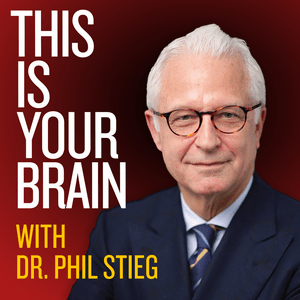
This Is Your Brain With Dr. Phil Stieg
Weill Cornell Medicine Neurological Surgery
Último episodio
203 episodios

Watch... Worry... Repeat: How Bad News Affects the Brain
13/11/2026 | 27 minDecades ago, we sat down for the news on TV. Now the news is pushed upon us through our phones, 24-hour streaming news channels and even at the gas pump. We scroll from one video to the next. Dr. Roxane Cohen Silver, a distinguished professor of psychology, public health, and medicine at the University of California, Irvine, has spent 40 years studying how our brains respond to never-ending loops of bad news. Her national studies of 9/11, the Boston Marathon bombings, and the COVID-19 pandemic turned up a startling finding: people who took in four to six hours a day of bombing coverage could end up more distressed than people who were actually there.
So why can't we look away? Silver says the more graphic imagery we take in, the more we worry … and the more we worry, the more we're pulled toward the next story. She discusses the impact of today's eyewitness videos delivered to us with no editor deciding what we see, and the simple habits she uses to stay informed without drowning. She reminds us that we can look away. Cutting back even a little may help.Medical Mini: Seeing Your Own Brain Before Surgery - Danielle Collins & Stefannie MacDonald
01/11/2026 | 10 minWhat if you could fly inside your own brain before surgery?
Welcome to Medical Minis, a new segment on This Is Your Brain.
Many of you have written asking about the surgeries Dr. Stieg performs, the patients he cares for, and the experiences and technologies that have shaped him. Your curiosity inspired a new addition to the show: short segments that take you behind the scenes of neurosurgery and into the operating room. We'll explore the tools and technologies we use, the decisions we face, and the human stories at the heart of our work.
In this Medical Mini, Dr. Phil Stieg talks with patient advocate Danielle Collins and Stefannie MacDonald, Head of Product Management at Surgical Theater. Danielle was in a workout class when a ruptured AVM in her temporal lobe hit her with a sudden, severe headache. In the hospital, a VR headset let her see her own brain in 3D while her surgeon walked her through the operation step by step. MacDonald explains how Surgical Theater turns CT and MRI scans into a patient-specific model, why surgeons rehearse each case before they operate, and why a person always checks the images. Danielle also talks about recovery, fear and living with intention.
"I was able to fly inside of my brain."
Surgical Theater - https://surgicaltheater.comMedical Mini: Making Sense of Your Medical Scan - Todd Goldberg, Avatar Medical
01/11/2026 | 9 minCould you read your own MRI?
Welcome to Medical Minis, a new segment on This Is Your Brain.
Many of you have written asking about the surgeries Dr. Stieg performs, the patients he cares for, and the experiences and technologies that have shaped him. Your curiosity inspired a new addition to the show: short segments that take you behind the scenes of neurosurgery and into the operating room. We'll explore the tools and technologies we use, the decisions we face, and the human stories at the heart of our work.
In this Medical Mini, Dr. Phil Stieg talks with Todd Goldberg, Chief Business Officer of Avatar Medical, about turning MRI and CT scans into personal 3D models. Scans were designed by and for radiologists: black and white, flipped left to right, and read slice by slice. Goldberg explains why a 3D model still needs a doctor to walk the patient through it, why a better scan makes a better model, and the questions Avatar asked more than 100 patients after consultations at five institutions. He also shares a family emergency from years ago, before tools like this were in the room, and why clearer images would have brought comfort even if the medical decision stayed the same.
"Actually having clarity on things is comfort. It does matter."
Avatar Medical - https://www.avatarmedical.aiMedical Mini: Seeing Surgery Differently - Jamie Lockwood, HMDmd
31/10/2026 | 8 minWhat if every monitor in the operating room sat right in front of the surgeon's eyes?
Welcome to Medical Minis, a new segment on This Is Your Brain.
Many of you have written asking about the surgeries Dr. Stieg performs, the patients he cares for, and the experiences and technologies that have shaped him. Your curiosity inspired a new addition to the show: short segments that take you behind the scenes of neurosurgery and into the operating room. We'll explore the tools and technologies we use, the decisions we face, and the human stories at the heart of our work.
In this first Medical Mini, Dr. Phil Stieg talks with Jamie Lockwood, CEO of HMDmd, about a head-mounted display that moves the operating room's screens from 8 to 12 feet away to right in front of the surgeon's eyes. Operating rooms are packed with stacked monitors and machines that don't talk to each other, and some cases run 8 to 10 hours. Lockwood explains how HMDmd adapted display technology from military aviation, including the F-35, to give surgeons 3D visualization without losing sight of the patient.
"You cannot be disconnected from your patient at any given time."
HMDmd - https://hmdmd.comAre You Addicted to Porn, or Just Feeling Guilty?
30/10/2026 | 28 minSome people who say they are addicted to porn barely use it at all. So what is really going on?
Psychologist Dr. Joshua Grubbs has an answer: moral incongruence. When our behavior clashes with our values, shame can feel exactly like addiction.
"When we're trying to regulate natural biological drives, it gets messy and complicated.
Dr. Phil Stieg and Dr. Grubbs explore where the clinical line really falls and why the wrong label can make things worse. Dr. Grubbs shares the one question to ask about any habit you cannot shake.
https://psych.unm.edu/people/faculty/profile/joshua-grubbs.html
Más podcasts de Ciencias









Podcasts a la moda de Ciencias


























Acerca de This Is Your Brain With Dr. Phil Stieg
This Is Your Brain With Dr. Phil Stieg provides a fascinating look into the human brain, with each episode asking new questions — and finding new answers — about our most mysterious organ. Together with his expert guests, Dr. Stieg takes us on a journey that reveals unexpected secrets at every turn, and redefines what we know about ourselves and our place in the world.
The podcast explores the many fascinating aspects of neuroscience, ranging from how the brain is wired for both sudden bursts of violence and the pervasive inner calm of meditation. Where does confidence come from? How do we remember traumatic events – or do we? How do other animals experience consciousness? Does storytelling change our brains?
Take the journey with us as we explore the very foundation of what makes us human.
Sitio web del podcastEscucha This Is Your Brain With Dr. Phil Stieg, Mándarax: ciencia en tu vida diaria y muchos más podcasts de todo el mundo con la aplicación de radio.net
Descarga la app gratuita: radio.net
- Añadir radios y podcasts a favoritos
- Transmisión por Wi-Fi y Bluetooth
- Carplay & Android Auto compatible
- Muchas otras funciones de la app
 México

