

Escucha gratis este podcast en la aplicación: Descarga gratuita en la App Store
radio.net
Sleep timer
Favoritos
59 episodios
Chip Craze: Framing Industrial Policy for the AI Era
11/08/2026 | 37 minThe AI-driven capex cycle might be the biggest investment story of the past century. The five largest hyperscalers were on track to spend around $800 billion on AI infrastructure in 2025, and as a share of U.S. GDP, AI capex has already eclipsed the dot-com boom of the 1990s. Chips are at the center of the AI frenzy – the same chips that also guide precision munitions and power satellite communications. In pursuit of a strategic advantage, nations are racing to shore up critical supply chains and achieve dominance in the economic arena. How will industrial policy's reemergence influence investment opportunities and global capital flows?
For a closer examination of industrial policy's risks and rewards, PGIM's Daleep Singh talks to Mike Schmidt, Distinguished Visitor at Princeton University's Griswold Center for Economic Policy and former Director of the CHIPS Program Office (CPO) at the U.S. Department of Commerce. The discussion covers topics including:
A framework for employing industrial policy effectively
Economic resilience and strategic dominance
Opportunities and challenges in ramping up U.S. chip production
Recent industrial policy actions and their market impact
How to prepare supply chains to withstand geopolitical weaponization or unexpected shocksThe Power Play: Is Fusion Nearing a Kitty Hawk Moment?
20/07/2026 | 23 minIn an era of AI, data centers and electrification, rising power demand presents a range of challenges and investment opportunities across the energy sector. Bottlenecks in the supply chain, such as the backlog in gas turbine production, have grabbed headlines while the power-hungry digital infrastructure buildout lifts energy consumption. With the grid increasingly strained, commercial-grade fusion power is one innovative solution emerging in a rapidly evolving energy landscape.
PGIM's Daleep Singh visits Commonwealth Fusion Systems CEO Bob Mumgaard for a conversation inside the facility that houses SPARC, the company's prototype for what could be the first commercially produced machine that generates net energy from fusion. This milestone – expected in 2027 – would be significant, paving the way for the first generation of fusion power plants. Like geothermal energy and small modular reactors, commercially viable fusion power could make the national grid better equipped to meet forecasts for intense electricity demand – using dispatchable, zero-carbon power that could be more resilient through periods of geopolitical strife. Institutional investors will continue to play a role in deploying the long-term capital needed to scale new technologies, expand the power grid, and fortify energy supply chains.
Listen for an inside look at the future of fusion power. This episode explores:
CFS's plans to establish the first ARC plant in the early 2030s – and its ambitions to build thousands more
The engineering and capital hurdles to create grid-scale fusion power plants
Industrial policy actions and public-private partnerships that could accelerate the fusion buildout
Why fusion energy's supply chain is less vulnerable to geopolitical chokepoints than traditional fuel sourcesWarsh's Opening Act: Inside the Fed's Regime Shift with James Bullard
07/07/2026 | 23 minThe arrival of Kevin Warsh as Chair of the Federal Reserve marked a regime shift. At its June meeting, the Federal Open Market Committee (FOMC) dropped its easing bias, opening the door to interest rate hikes as supply shocks collide with hotter demand. The Fed also announced five new task forces to evaluate key priorities, from inflation frameworks to AI's impact on productivity and the labor market. Under Warsh, the central bank sent an unmistakable message: This is just the opening act for a very different Fed.
James Bullard, former President and CEO of the Federal Reserve Bank of St. Louis and current Dean of the Mitch Daniels School of Business at Purdue University, joins PGIM's Daleep Singh to analyze the start of the Warsh era at the Fed. They discuss policy challenges from inflation's resurgence, the case for lower rates over the long run, and potential market implications if the Fed changes how it conducts monetary policy.
The conversation also covers:
The Fed's reaction function amid policy shifts and economic transformation
Emerging similarities to the Fed's Greenspan era
How changes to Fed communications and forward guidance could influence markets
Economic outcomes from the AI boom – and why fears of job destruction might be overblownStrategic Stalemate: What Investors Miss About U.S.-China Competition
08/06/2026 | 37 minThe military concept of escalation dominance posits that the side controlling the pace and pain of a conflict determines the outcome. For most of the Cold War era, the U.S. had escalation dominance—militarily, technologically, and economically—but the use of economic statecraft was limited. That era is over. As great power competition intensifies, the relationship between the U.S. and China offers a view into where competition is headed and what it means for global stability. While the U.S.-China summit resulted in an effective truce, there are deeper takeaways that investors and other observers should consider.
PGIM's Daleep Singh welcomes Julian Gewirtz, former Senior Director for China and Taiwan Affairs at the National Security Council, to discuss the U.S.-China stalemate and the economic long game. The conversation covers topics including:
Geopolitical and economic takeaways from the summit
China's efforts to buy time—and potential U.S. policy responses
Technological competition, including AI, chips and related minerals
Strategies aimed at achieving AI superiority in pursuit of national interestsBeyond the Battlefield: Chokepoints in the Age of Economic Warfare
06/05/2026 | 44 minGlobal conflicts are increasingly playing out in the economic arena, not just on the battlefield. The war in Iran represents a collision of both. Physical and financial chokepoints can be used for strategic leverage; they also raise potential vulnerabilities. To unpack how and why economic warfare is reshaping the macro landscape, Daleep Singh speaks with Edward Fishman, author of "Chokepoints: American Power in the Age of Economic Warfare" and Senior Fellow and Director of the Maurice R. Greenberg Center for Geoeconomics at the Council on Foreign Relations.
The discussion explores how investors can evaluate resilience to economic vulnerabilities, the future of economic statecraft amid heightened geopolitical competition, and chokepoints that investors should be watching in the future.
Más podcasts de Economía y empresa
 Chisme CorporativoEconomía y empresa
 WhitepaperAdministración, Economía y empresa, Empresa, Inversión
 Cuéntame de economíaEconomía y empresa, Empresa
 Libros para EmprendedoresAdministración, Economía y empresa, Empresa, Marketing
 Espresso Matutino El PodcastEconomía y empresa, Noticias, Noticias diarias, Noticias financieras
 Hágale como quieraEconomía y empresa
 The Diary Of A CEO with Steven BartlettCultura y sociedad, Economía y empresa, Educación
 Cracks Podcast con Oso TravaCultura y sociedad, Economía y empresa, Salud y forma física
 CREATIVOEconomía y empresa
 SINERGÉTICOSEconomía y empresa, Empresa
Podcasts a la moda de Economía y empresa
 Compartiendo con Marisa LazoEconomía y empresa
 SPEAK LIKE A CEOEconomía y empresa
 No es el dinero, eres tú. El podcast.Economía y empresa
 Campeones FinancierosEconomía y empresa, Inversión
 The Prof G Pod with Scott GallowayEconomía y empresa, Empresa
 Coaching for LeadersAdministración, Carrera, Economía y empresa, Educación, Superación personal
 Audio Podcast | Actitud Millonaria por Josue PeñaEconomía y empresa, Empresa
 Neurona Financiera: Finanzas Personales e InversionesEconomía y empresa, Empresa, Marketing
 The Cardone ZoneCarrera, Economía y empresa
 EmprendedurosAdministración, Economía y empresa, Empresa, Inversión
 Contrapunto por Luis GonzaliEconomía y empresa, Inversión
 FoundersEconomía y empresa, Empresa, Historia, Tecnología
 The Knowledge ProjectCultura y sociedad, Economía y empresa, Educación, Empresa, Superación personal, Tecnología
 El PodCash con Luis Mi NegociosEconomía y empresa, Empresa
 Métele lana y neuronasEconomía y empresa, Salud mental, Salud y forma física
 Working Hard with Grace BeverleyEconomía y empresa, Educación, Marketing, Salud y forma física, Superación personal
 Aléjate del 97%Economía y empresa, Educación, Empresa, Superación personal
 Adrián Sáenz PodcastEconomía y empresa, Empresa
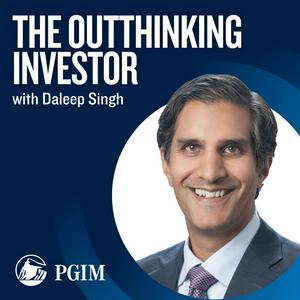
Acerca de The Outthinking Investor with Daleep Singh
In today's ever-changing world, investors should challenge old assumptions and think outside the box.
Markets trade on more than just economic data. They trade on geopolitics, technology, policy, and elections. In a world searching for a new equilibrium, old assumptions are expensive mistakes. Daleep Singh, Vice Chair and Chief Global Economist at PGIM, has spent his career at the intersection of markets and policy, from the U.S. Treasury and Federal Reserve to the White House. Now, Daleep is sharing his perspectives with you.
On PGIM's The Outthinking Investor, Daleep sits down with prominent economists, technologists, policymakers, and market veterans to map out the full distribution of what comes next—and why it matters.
Sitio web del podcastEscucha The Outthinking Investor with Daleep Singh, Chisme Corporativo y muchos más podcasts de todo el mundo con la aplicación de radio.net
Descarga la app gratuita: radio.net
- Añadir radios y podcasts a favoritos
- Transmisión por Wi-Fi y Bluetooth
- Carplay & Android Auto compatible
- Muchas otras funciones de la app
Descarga la app gratuita: radio.net
- Añadir radios y podcasts a favoritos
- Transmisión por Wi-Fi y Bluetooth
- Carplay & Android Auto compatible
- Muchas otras funciones de la app

The Outthinking Investor with Daleep Singh
Escanea el código,
Descarga la app,
Escucha.
Descarga la app,
Escucha.
The Outthinking Investor with Daleep Singh: Podcasts del grupo
 México