

Escucha gratis este podcast en la aplicación: Descarga gratuita en la App Store
radio.net
Sleep timer
Favoritos
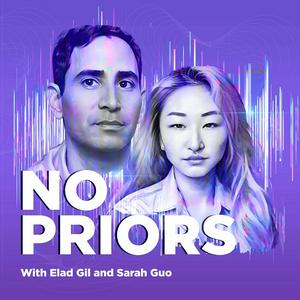
No Priors: Artificial Intelligence | Technology | Startups
Conviction
Último episodio
182 episodios

Beam: The Great American Open Model with ReflectionAI Co-Founder and CEO Misha Laskin
09/10/2026 | 1 h 9 minIs the future of frontier AI open or closed? ReflectionAI co-founder and CEO Misha Laskin joins Sarah Guo and Elad Gil to discuss the launch of Beam, the company’s 500 billion parameter open-weight reasoning model. Misha breaks down the pre-training and reinforcement learning required to produce Beam’s reasoning efficiency, the shift in enterprise compute from renting to owning intelligence, and how he believes that open models will capture the majority of global token demand. He also talks about the open model ecosystem in China and why competition with China’s models is a good thing, safety considerations around open models, and how frontier-level open models may accelerate the pace of scientific discovery.
Sign up for new podcasts every week. Email feedback to show@no-priors.com
Follow us on Twitter: @NoPriorsPod | @Saranormous | @EladGil | @MishaLaskin | @reflection_ai
Chapters:
00:42 – Misha Laskin Introduction
00:59 – Latest with ReflectionAI
02:07 – Challenges Building an Open Model
03:56 – ReflectionAI’s Agentic Shift
07:37 – Resources for Model Training
10:09 – Scaling Efficiency
12:18 – Training Beam
16:51 – Where Model Value Comes From
19:55 – Beam’s Reasoning Efficiency
22:35 – Monetizing Open Weight Models
25:03 – Future of Open Versus Closed Tokens
31:29 – Competition with Open Models
34:38 – Chinese Open Source Model Ecosystem
38:40 – Will Chinese Models Remain Open
44:44 – Safety and Open Models
53:02 – Debating Access to Powerful Tools
57:16 – AI and Scientific Progress
01:00:36 – Data Centers and Jobs
01:02:07 – Beam and Scientific Research
01:05:37 – Research Head Count to Compute Ratio
01:10:29 – ConclusionFrontier Chips for Frontier AI Labs, with Walter Goodwin, Founder/CEO of Fractile
02/10/2026 | 35 minFounder and CEO of full-stack AI chip company Fractile, Walter Goodwin, joins Sarah Guo to discuss the bets he’s made on the future of the chip market as other major players like Broadcom, NVIDIA, and AMD try to accelerate their workloads. They discuss the difference in Fractile’s newer approach on model architecture with a full-stack team in the current chip landscape and the technical bets they’re making in that direction. Walter also talks about compressing the gap between the chip design cycle and its payoff period, and making a generational leap in AI inference to realize the bet in volume against the value to be captured.
Sign up for new podcasts every week. Email feedback to show@no-priors.com
Follow us on Twitter: @NoPriorsPod | @Saranormous | @EladGil | @goodwin_ml | @fractile_ai
Chapters:
00:46 – Walter Goodwin and Fractile Introduction
02:29 – The Chip Landscape Now
04:56 – Common Handoffs From Architecture-Focused Players
07:18 – Full Stack Approach and Team Setup
09:49 – Fractile’s Most Important Technical Bets
15:32 – Workload Predictions and Compressing the Chip Design Cycle
23:03 – Architect Intent to Output Bottlenecks and Accelerating Trials
28:16 – Workload Bets on Model Architectural Shifts
31:20 – The Future of AI Chip Players and Market Structure
35:14 – ConclusionRe-Founding Incumbents for the AI Era with Sequence Holdings Co-Founder and CEO Michael Lee
24/09/2026 | 42 minCan AI transform legacy incumbents rather than replacing them? Sequence Holdings co-founder and CEO Michael Lee joins Sarah Guo to discuss how holding company structures and engineering integrations are reshaping market leaders from the inside out. Michael details Sequence’s $7.7 billion take-private transaction of Baldwin alongside Dell Family Office (DFO), and shares his thesis on why traditional consulting models and software sales fall short for real enterprise AI transformations. They also talk about why permanent holding company structures are good for long-term compounding, real-world results from applying frontier engineering to BankSouth, and Michael’s lessons from his time in public investing, private equity, and operating at the intersection of market incumbents and AI.
Sign up for new podcasts every week. Email feedback to show@no-priors.com
Follow us on Twitter: @NoPriorsPod | @Saranormous | @EladGil | @mjlee_2014 | @seqholdings
Chapters:
00:34 – Michael Lee Introduction
01:03 – Sequence Holdings and Baldwin
01:54 – Idea for Sequence
04:36 – Incumbents in the AI Era
06:32 – Why a Holding Company
11:21 – Recruiting Top Engineers
13:08 – Investing in BankSouth
17:46 – Why an Insurance Brokerage
20:17 – Atlas Platform Explained
23:53 – Traditional Private Equity Limitations
27:23 – What Sequence Looks For in Management Teams
31:04 – Accomplishments at BankSouth
34:45 – Founder Lessons
36:08 – Story of Dell Partnership
37:10 – Career and Investment Approach
40:00 – Value of Exceptional People
42:23 – ConclusionWhy Diffusion Will Win AI Inference with Inception Co-Founder and CEO Stefano Ermon
18/09/2026 | 38 minAs generative AI hits hardware and latency bottlenecks, Stanford professor, diffusion pioneer, and Inception co-founder and CEO Stefano Ermon is betting on a radical new architecture. Stefano joins Sarah Guo to talk about Inception, and how his team is applying diffusion architecture beyond images and video into discrete text and code generation. Stefano explains the limitations of autoregressive LLMs, as well as why parallel token generation in diffusion models offers superior inference scaling and hardware utilization on standard GPUs. He also shares details about Inception’s Mercury models, real-world voice agent applications, the software stack required to serve diffusion-based models at scale, academia’s role at the frontier of AI innovations, and why the next era of AI competition will be defined by efficiency.
Sign up for new podcasts every week. Email feedback to show@no-priors.com
Follow us on Twitter: @NoPriorsPod | @Saranormous | @EladGil | @StefanoErmon | @_inception_ai
Chapters:
00:00 – Stefano Ermon Introduction
00:35 – Research Background
02:54 – Starting Inception
05:59 – Why Diffusion Beats Autoregressive
11:10 – Discrete vs. Continuous Modalities
13:19 – Inception Today
16:45 – Where Speed Wins
17:31 – Inception Customer Base
18:49 – Interaction with Hardware Landscape
19:34 – Inception and the Broader Industry
21:41 – Data Compression and Structure
24:45 – Controllability of Diffusion Modeles
27:25 – Emergent Capabilities at Scale
29:02 – Future Workload Split Between Diffusion vs. Traditional
30:03 – Adoption Challenges
31:44 – Hiring and Team Organization
32:50 – Recursive Self Improvement
34:02 – Resource Allocation
35:10 – Impact of Academia
38:13 – ConclusionCoinbase’s Everything Exchange: Agentic Finance, Stablecoins, and Tokenization with CEO Brian Armstrong
10/09/2026 | 45 minFrom the tokenization of real-world assets to funding research on anti-aging therapeutics, Coinbase co-founder and CEO Brian Armstrong is focused on solving meta-problems for the benefit of society. Brian joins Elad Gil this episode to discuss the intersections of artificial intelligence, crypto rails, and biotechnology. He details Coinbase’s vision for agentic finance, as well as how Coinbase is becoming the ‘Everything Exchange’, which includes tokenized real-world stocks, stablecoin payment adoption, and prediction markets. Brian also introduces his new venture, New Limit, a company founded to tackle longevity through epigenetic reprogramming, and outlines initial therapeutic programs and the roadmap toward clinical trials.
Sign up for new podcasts every week. Email feedback to show@no-priors.com
Follow us on Twitter: @NoPriorsPod | @Saranormous | @EladGil | @brian_armstrong | @Coinbase
Chapters:
00:00 – Cold Open Trailer
00:45 – Brian Armstrong Introduction
01:13 – Coinbase and the Everything Exchange
05:52 – Agentic Commerce
10:00 – AI and Crypto
10:49 – AI Inside Coinbase
15:39 – Productivity and Company Size
17:26 – The Everything Exchange and Tokenization
20:53 – Prediction Markets
23:15 – Introducing New Limit
34:17 – Looking Forward Five Years
40:24 – Special Economic Zones
44:26 – Conclusion
Más podcasts de Ciencias








Podcasts a la moda de Ciencias



















Acerca de No Priors: Artificial Intelligence | Technology | Startups
At this moment of inflection in technology, co-hosts Elad Gil and Sarah Guo talk to the world's leading AI engineers, researchers and founders about the biggest questions: How far away is AGI? What markets are at risk for disruption? How will commerce, culture, and society change? What’s happening in state-of-the-art in research? “No Priors” is your guide to the AI revolution. Email feedback to show@no-priors.com.
Sarah Guo is a startup investor and the founder of Conviction, an investment firm purpose-built to serve intelligent software, or "Software 3.0" companies. She spent nearly a decade incubating and investing at venture firm Greylock Partners.
Elad Gil is a serial entrepreneur and a startup investor. He was co-founder of Color Health, Mixer Labs (which was acquired by Twitter). He has invested in over 40 companies now worth $1B or more each, and is also author of the High Growth Handbook.
Sitio web del podcastEscucha No Priors: Artificial Intelligence | Technology | Startups, Hidden Brain y muchos más podcasts de todo el mundo con la aplicación de radio.net
Descarga la app gratuita: radio.net
- Añadir radios y podcasts a favoritos
- Transmisión por Wi-Fi y Bluetooth
- Carplay & Android Auto compatible
- Muchas otras funciones de la app
Descarga la app gratuita: radio.net
- Añadir radios y podcasts a favoritos
- Transmisión por Wi-Fi y Bluetooth
- Carplay & Android Auto compatible
- Muchas otras funciones de la app

No Priors: Artificial Intelligence | Technology | Startups
Escanea el código,
Descarga la app,
Escucha.
Descarga la app,
Escucha.
No Priors: Artificial Intelligence | Technology | Startups: Podcasts del grupo
 México