
Escucha gratis este podcast en la aplicación: Descarga gratuita en la App Store
radio.net
Sleep timer
Favoritos
AI and the Future of Work: Artificial Intelligence in the Workplace, Business, Ethics, HR, and IT for AI Enthusiasts, Leaders and Academics
Dan Turchin
Último episodio
384 episodios
411: Jeremy Burton, GM of Observability at Snowflake: The Data Layer Was Never a Commodity. It’s the Whole Game
26/10/2026 | 44 minSend us Fan Mail
Jeremy Burton is the General Manager for Observability Business Unit at Snowflake following the acquisition of Observe, the developer-centric observability platform where he served as CEO. A veteran enterprise technology executive with a thirty-year career spanning Silicon Valley, Jeremy previously served as Executive Vice President of Marketing and Corporate Development at Dell, President of Products at EMC, and CEO of Serena Software, with earlier leadership roles at Symantec, Veritas, and Oracle. He has served on Snowflake’s board of directors since 2015 and sits on the McLaren Racing Advisory Board.
In this episode, Jeremy draws on watching customers go from collecting a petabyte of data in a decade to generating one every two days to make the case that without a real data foundation, enterprises will either get the wrong answer from their AI, or burn a fortune getting to the right one.
In this conversation, we discuss:
Why pointing AI agents at hundreds of terabytes of telemetry burns tokens fast, and what Jeremy says has to change first.
How an AI agent facing 10 sources of truth can deliver the wrong answer with total confidence.
Why Jeremy calls the LLM “a new animal in the zoo,” and what that means for anyone trying to monitor AI agents.
How AI agents are starting to build the knowledge graphs that once took human implementation teams to create.
Why evals are becoming essential to running an LLM, and what a single model release can do to existing applications.
What Jeremy would tell his younger self stepping off the plane to meet Mark Benioff, and the career superpower he undervalued.
Explore the conversation:
00:00 Intro and AI Fun Fact: Pope Leo XIV's Encyclical and Anthropic's Vatican Address
04:08 Introducing Jeremy Burton, GM for Observability at Snowflake and Former CEO of Observe
07:09 The Observe Origin: Pitching Observability as a Unified Data Problem Natively on Snowflake
10:20 Observability as a Data Problem: Metrics, Logs and Traces
13:39 Snowflake Culture and Leadership Eras
16:58 Joining Snowflake: Running Observe After the Acquisition
18:57 Data Foundation vs. Frontier Models: Balancing CPU and GPU Burn with Context
22:23 Snowflake's AI Strategy: Data Foundation and Sources of Truth
28:11 Non-Human AI Telemetry: Using Knowledge Graphs to Structure Machine Data
32:31 Probabilistic AI and LLM Observability: Why Evals and Harnesses Are Essential
36:14 Future of Work: The "LLM as Modern-Day Tractor" and Software Engineering Practices
41:18 Career Superpowers: The Value of Networks and Relationships in Silicon Valley
43:06 Closing: Where to Connect with Jeremy Burton and Explore Snowflake Observability
Resources:
Subscribe to the AI & The Future of Work Newsletter
Connect with Jeremy Burton on LinkedIn
AI fun fact article
On How Ashu Garg, General Partner at Foundation Capital, finds and invests in the future of AI
Other episodes mentioned on the show: Automate the Work, Amplify the Humanity, with Snowflake's CPO Arnnon Geshuri
-
Learn how Box connects secure enterprise content with AI to power smarter workflows. Visit box.com/ai to learn more.410: Johanna Jackman, Chief People Officer at Freshworks: Responsible AI Isn’t Slow. It’s Bold, With Human Judgment
19/10/2026 | 47 minSend us Fan Mail
Johanna "JJ" Jackman is the Chief People Officer at Freshworks, the global cloud-based customer service and IT service management platform serving over 75,000 corporate clients worldwide. With an international career across six countries, JJ began her professional journey in the Australian mining industry before transitioning into high-growth technology.
Prior to joining Freshworks in 2023, she served as Chief People Officer at Airtable, Chief Human Resources Officer at Pure Storage, and Vice President of HR at LinkedIn during its formative scaling era, and currently sits on the Board of Directors at Grafana Labs.
In this episode, JJ sits down with Dan to discuss why modern employee experience requires transitioning from traditional organizational charts to workflow-centric platforms, how HR functions as Customer Zero to eliminate operational friction across enterprise IT and HR services, why executive leaders must share responsibility with employees for continuous AI fluency, and how the convergence of human judgment with digital teammates is redefining workforce planning and career mobility.
In this conversation, we discuss:
Why evaluating enterprise software transformation requires abandoning rigid organizational charts in favor of end-to-end, workflow-centric employee experiences.
How serving as "Customer Zero" allows internal people teams to co-design IT and HR service platforms that eliminate administrative friction for global workforces.
What the creation of dedicated AI enablement roles reveals about shifting corporate strategy from traditional headcount planning to dynamic capability modeling.
Why fostering organizational resilience requires a mutual commitment between employers and workers to maintain continuous AI fluency and career relevance.
How enterprise leaders can establish transparent guardrails to ensure autonomous algorithms inform decision-making without supplanting human judgment.
What a data-driven, structured job search framework teaches early-career professionals about asserting personal agency in an algorithmically filtered hiring market.
Explore The Conversation
00:00 Intro and listener mailbag: Allison in Trenton on special episode 21 and WEF global job trends
02:35 Introducing Johanna "JJ" Jackman, Chief People Officer at Freshworks
04:09 From mining underground to tech executive: Formative lessons in human-centric leadership
06:22 The Freshworks culture trifecta: Manager support, peer collaboration, and goal clarity
08:47 From org charts to workflows: Framing "People Platform as a Service" with IT leadership
12:08 HR as customer zero: Streamlining Lives HR and eliminating friction across the employee journey
15:32 Rewriting the employment contract: Executive role-modeling and shared AI fluency
21:45 Capacity over headcount: "AI in Motion" days and hiring an AI enablement leader
29:48 Responsible AI in HR: Safeguarding human judgment in promotion and performance decisions
33:34 Empowering early-career professionals: Agency, unlearning, and Josh's mathematical job hunt
41:52 The 2031 vision: Digital employee IDs, merging CPO-CIO roles, and remote leadership
45:01 Closing: Where to connect with Johanna "JJ" Jackman and explore Freshworks
Resources:
Subscribe to the AI & The Future of Work Newsletter
Connect with Johanna "JJ" Jackman on LinkedIn
Other episodes and research mentioned on the show:Special Episode 21 featuring Charlene Li, Daphne Jones, Patty Hatter, Mona Sabet, and Tess Posner on female leadership in AI
-
See why Freshworks was named a Leader in the 2026 Gartner® Magic Quadrant™ for ITSM. Learn more → freshworks.com/dant409: Ryan Gavin, CMO at Slack: AI Is Single-Player. Slack Is Betting on Multiplayer
12/10/2026 | 41 minSend us Fan Mail
Ryan Gavin is Chief Marketing Officer at Slack, the global collaboration platform used by more than 200,000 organizations across 150 countries. Since joining Slack, Ryan has helped drive a 250% increase in revenue while championing the launch of Slack's AI-first capabilities and agentic integrations.
A seasoned technology executive, Ryan previously served as Chief Growth Officer at Convoy and held senior leadership roles at Amazon Web Services and Microsoft, where he managed multi-billion-dollar business units.
In this episode, Ryan draws on watching hundreds of enterprise AI rollouts up close to make the case that dropping agents into an organization without a strategy doesn't just fail to help, it actively backfires.
In this conversation, we discuss:
Why single-player AI tools fail to deliver enterprise productivity gains, and how deploying autonomous agents into collaborative, multiplayer environments unlocks hidden software value.
How a conversational interface connects unstructured team dialogue with structured CRM data, allowing employees to query enterprise systems without opening underlying software tabs.
What the concept of "headless software" reveals about democratizing access to sales and operational insights across non-technical departments.
Why transparent, step-by-step reasoning and strict permission inheritance are essential for building trust when introducing AI tools into enterprise workflows.
How leading organizations elevate Slack from a conventional IT collaboration expense into a core strategic driver for company-wide AI adoption.
What executive advice for emerging professionals highlights the enduring value of curiosity, creativity, and adaptability in a rapidly changing job market.
Explore the conversation
00:00 Show Intro, a Team Human Success Story, and Meet Ryan Gavin
03:44 Ryan Gavin's Path to Becoming CMO of Slack
04:57 Slack's New Job in the Age of AI Agents
07:53 Designing SlackBot to Strengthen Human Collaboration
12:31 Headless Salesforce and Slack as the New Front Door
16:50 Slack as 2% of Your AI Budget and the Problem With 'Work About Work'
21:37 Trust, Transparency, and the AI Black Box in SlackBot
25:28 From Slash Commands to Every Employee as a Builder
31:40 Winning Share of Wallet in a Zero-Sum AI Budget
35:54 Advice for Workers Who Feel Left Behind by AI
39:35 Where to Find Ryan Gavin and Slack
Resources
Subscribe to the AI & The Future of Work Newsletter
Connect with Ryan on LinkedIn
Other episodes mentioned on the show:On How Silvio Savarese, EVP and Chief Scientist at Salesforce, navigated the real challenges of taking AI from the ivory tower to corporate labs (Episode 297)
On How Kai Nunez, Vice President of Research & Insights at Salesforce, shares the secret to making tech teams own responsibility for AI ethics (Season 2, Episode 47)
-
See why Freshworks was named a Leader in the 2026 Gartner® Magic Quadrant™ for ITSM. Learn more → freshworks.com/dantSE 31: Kartik Sakthivel, CIO at John Hancock | Live from Ai4 2026
08/10/2026 | 35 minSend us Fan Mail
Kartik Sakthivel is the Chief Information Officer at John Hancock, the life insurer that turned 164 years old in April 2026 and is part of Manulife. Before joining, he spent eight and a half years at LIMRA and LOMA, the oldest and largest trade association in financial services, which gave him a view across carriers few technology leaders ever get.
Recorded live from the floor of Ai4 2026, this lightning round explores what it takes to bring AI into a company founded during the Civil War, and why he tells his teams that what they build today becomes the legacy for the next 164 years.
Kartik and host Dan Turchin dig into why he believes every technology leader should think of themselves as a business leader first, how a regulated industry decides what to fast track and what to slow down, and what he says to people who are watching a machine learn to do the thing that made them valuable.
What You'll Learn
Why uptime and mean time to repair are table stakes for a modern technology organization, and what Kartik measures instead
How a highly regulated business draws the line between internal AI that gets fast tracked and anything customer facing that does not
Why there are more AI pilots in insurance than planes at a major airport at peak hour, and how to find use cases that are neither too small to matter nor too large to finish
The question he asks every time the business brings him an AI idea, and why the answer is sometimes something far simpler
What he tells colleagues watching automation absorb part of their role, and where the time that comes back should be reinvested
🎙️ Part of our Ai4 2026 compilation series.
Listen to the full compilation here: https://www.buzzsprout.com/520474/episodes/19816277
Resources
Subscribe to the AI & The Future of Work Newsletter
Connect with Kartik on LinkedIn408: Cesar Carvalho, CEO of Wellhub: The Risk Isn't AI. It's How Fast You Grow.
05/10/2026 | 40 minSend us Fan Mail
Cesar Carvalho is the co-founder and CEO of Wellhub, the corporate well-being platform connecting millions of employees to top-tier fitness, mindfulness, therapy, nutrition, and sleep partners across 18 countries.
Since founding the company as Gympass in 2012, Cesar has raised nearly $900 million in venture funding, reached a $2.4 billion valuation, and grown Wellhub to serve over 50,000 corporate clients worldwide.
In this episode, Cesar sits down with Dan to discuss why treating employee wellness and business performance as opposing forces is a false dichotomy. Tune in to hear his perspective on why AI should be leveraged to fund employee reskilling rather than justify job cuts, how Wellhub's AI wellness coach scales hyper-personalized care to millions of subscribers, why less than 10% of global healthcare spending goes toward prevention, and how pivoting during the 2020 pandemic transformed a near-death crisis into a multi-product wellness ecosystem.
In this conversation, we discuss:
Why framing corporate wellness as an adversary to business performance is a false dichotomy, and how employee health directly drives bottom-line execution.
How granting employees 30 minutes of paid work time daily to experiment with AI tools fosters a culture of innovation and continuous reskilling.
What the structural imbalance between preventive "well care" and reactive "sick care" reveals about the urgent need to redesign enterprise benefits.
How an AI-powered wellness coach expands personalized fitness and mindfulness guidance from hundreds of thousands to millions of corporate subscribers.
Why strict data minimization policies and phased beta testing provide a trusted framework for deploying AI in sensitive health environments.
What pivoting a global business model during the 2020 pandemic teaches founders about mission alignment, resilience, and turning near-death moments into catalysts for growth.
Explore the conversation:
00:00 Show Intro and Newsletter Shoutouts
02:07 AI Fun Fact: Chatbots and Mental Health Risks
04:01 Introducing Cesar Carvalho, CEO of Wellhub
05:03 From Harvard Dropout to Corporate Wellness: The Founding of Gympass
06:56 The "Team Human" Ethos: Making Well-Being Ubiquitous at Scale
09:14 Performance vs. Health: Why Employee Well-Being Directly Drives Execution
12:37 Calling Out AI Layoffs: Are Employees Expendable?
14:12 Reskilling Over Layoffs: Why Wellhub Invests in Existing Talent
16:34 Personalization at Scale: Expanding the AI Wellness Coach Across Millions
20:19 Responsible AI at Wellhub: Data Minimization and Governance Standards
22:36 Sick Care vs. Well Care: Quantifying a 20-35% Drop in Healthcare Costs
26:36 Eliminating Friction: Redesigning Employee Benefits Outside Open Enrollment
32:02 Human-First Design and Why AI Will Disrupt Legacy Companies
33:23 The Pandemic Pivot: Turning a Near-Death Event into Wellhub's Evolution
37:27 Advice to His Younger Self and the Best Time to Start a Company
39:45 Closing Thoughts and Sign-Off
Resources:
Subscribe to the AI & The Future of Work Newsletter
Connect with Cesar on LinkedIn
AI Fun Fact
On how one good decision made Thomas Otter (venture capitalist at Acadian Ventures) an accidental HR tech pioneer
-
See why Freshworks was named a Leader in the 2026 Gartner® Magic Quadrant™ for ITSM. Learn more → freshworks.com/dant
Más podcasts de Administración


Podcasts a la moda de Administración


Acerca de AI and the Future of Work: Artificial Intelligence in the Workplace, Business, Ethics, HR, and IT for AI Enthusiasts, Leaders and Academics
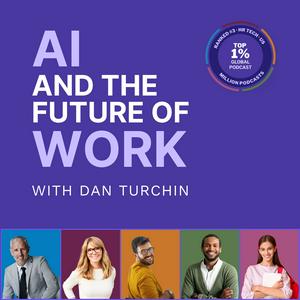
🏆 Ranked #3, Best Tech Podcasts — Million Podcasts (2026) | Top 1% global podcast. 450+ episodes. 10M+ downloads. Host Dan Turchin, PeopleReign CEO, explores how AI is changing the workplace. He interviews thought leaders and technologists from industry and academia who share their experiences and insights about artificial intelligence and what it means to be human in the era of AI-driven automation. Learn more about PeopleReign, the system of intelligence for IT and HR employee service: http://www.peoplereign.io.
Sitio web del podcastEscucha AI and the Future of Work: Artificial Intelligence in the Workplace, Business, Ethics, HR, and IT for AI Enthusiasts, Leaders and Academics, The McKinsey Podcast y muchos más podcasts de todo el mundo con la aplicación de radio.net
Descarga la app gratuita: radio.net
- Añadir radios y podcasts a favoritos
- Transmisión por Wi-Fi y Bluetooth
- Carplay & Android Auto compatible
- Muchas otras funciones de la app
Descarga la app gratuita: radio.net
- Añadir radios y podcasts a favoritos
- Transmisión por Wi-Fi y Bluetooth
- Carplay & Android Auto compatible
- Muchas otras funciones de la app

AI and the Future of Work: Artificial Intelligence in the Workplace, Business, Ethics, HR, and IT for AI Enthusiasts, Leaders and Academics
Escanea el código,
Descarga la app,
Escucha.
Descarga la app,
Escucha.
AI and the Future of Work: Artificial Intelligence in the Workplace, Business, Ethics, HR, and IT for AI Enthusiasts, Leaders and Academics: Podcasts del grupo
 México