
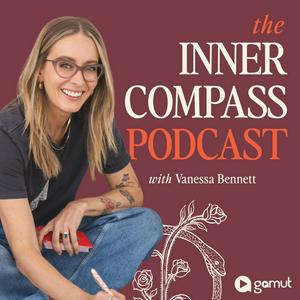
The Inner Compass Podcast with Vanessa Bennett
Gamut Podcast Network

Último episodio
276 episodios
- If you’ve ever gone through something that changed you so completely that the language of “getting back to normal” started to feel almost insulting, this episode is for you. Vanessa explores initiation as the kind of rupture that does not return us to who we were, but reorganizes the self entirely. Through rites of passage, liminality, trauma, witness, and the loss of ritual in modern life, we look at why some experiences are not interruptions to the old life, but thresholds into another one. The invitation is to stop measuring healing by whether you can become who you were before, and begin asking what kind of life can be built around who you are now.
For educational purposes only. This isn’t therapy.
Early applications for the next cohort of Inner Compass Academy are now open to the waitlist only.
If you’ve been feeling called toward deeper work with depth psychology, shadow, somatics, the unconscious, relational patterns, and learning how to hold space with more consciousness and integrity, this is the first window to apply.
The early application window is only open for one week. Those who submit during this window will receive early bird pricing, which is $200 off tuition, as well as access to extended payment plan options.
Again, this early application window is for the waitlist only, and it closes in one week.
Join the waitlist and find the application here:
https://www.vanessabennett.com/inner-compass-academy
Additional Resources
Explore: VanessaBennett.com
Book: The Motherhood Myth
Community: Inner Compass Collective
Training: Inner Compass Academy
Connect with Inner Compass
Follow on Instagram
Connect with Vanessa Bennett:
Follow on Instagram
Follow on TikTok
Learn more on Substack
Connect with Vanessa Bennett on LinkedIn
See Privacy Policy at https://art19.com/privacy and California Privacy Notice at https://art19.com/privacy#do-not-sell-my-info. - Narcissism is usually imagined as arrogance, dominance, and the loudest person in the room, but it is not always that obvious. In this episode, Vanessa explores narcissism as a problem of selfhood: what happens when a person does not have a stable enough inner sense of Self to stay emotionally coherent without constant reflection from the outside. Through Kohut, Kernberg, the myth of Narcissus, vulnerable and grandiose narcissism, the false self, parental overvaluation, and the difference between traits and Narcissistic Personality Disorder, we look at why these dynamics can feel so confusing inside real relationships. The question is not only whether someone can be charming, wounded, or empathic when things are easy, but whether they can stay curious about your reality when it no longer mirrors back the version of themselves they need to see.
For educational purposes only. This isn’t therapy.
Join Vanessa for the free Inner Compass Academy Summit, August 5–7, where we’ll explore depth psychology, shadow, embodiment, and what real transformation asks of us. Register here: https://www.vanessabennett.com/ica-summit
Reference Links:
Heinz Kohut — Self Psychology
Use for: Kohut’s self psychology, narcissism, mirroring, and development of a cohesive sense of self.
Link: https://www.sciencedirect.com/topics/nursing-and-health-professions/self-psychology
Note: ScienceDirect overview identifies Kohut as the theorist most associated with self psychology and describes his focus on the development of a cohesive and positive sense of self.
Kohut’s Self Psychology Model / Narcissism
Use for: Kohut’s view of narcissism, unmet selfobject needs, and narcissism as part of development rather than simple arrogance.
Link: https://pmc.ncbi.nlm.nih.gov/articles/PMC2860525/
Note: Useful accessible clinical article describing therapy through Kohut’s self psychology model.
Selfobject
Use for: Kohut’s selfobject concept: another person experienced as part of the self’s regulation and cohesion, rather than fully as a separate subject.
Link: https://www.encyclopedia.com/psychology/dictionaries-thesauruses-pictures-and-press-releases/self-object
Note: Use for the episode’s explanation of relationships organized around mirroring and self-regulation.
Narcissus Myth
Use for: Narcissus as the mythic image of attachment to reflection/image rather than real mutual relationship.
Link: https://www.britannica.com/topic/Narcissus-Greek-mythology
Note: Use as the basic myth reference. The episode’s psychological interpretation is Vanessa’s depth-oriented reading.
Otto Kernberg — Pathological Narcissism / Grandiose Self
Use for: Kernberg’s work on pathological narcissism, object relations, and the grandiose self.
Link: https://pubmed.ncbi.nlm.nih.gov/2678027/
Note: PubMed abstract summarizes Kernberg’s theory and mentions treatment focused on the pathologic grandiose self.
Otto Kernberg — Borderline Conditions and Pathological Narcissism
Use for: Primary book reference for Kernberg’s work on pathological narcissism.
Link: https://www.bloomsbury.com/us/borderline-conditions-and-pathological-narcissism-9780876681770/
Note: Book citation for producer if referencing Kernberg’s broader theoretical framework.
Grandiose and Vulnerable Narcissism
Use for: Distinction between grandiose narcissism and vulnerable / hypersensitive narcissism.
Link: https://pmc.ncbi.nlm.nih.gov/articles/PMC5601176/
Note: Research article describing grandiose narcissism as overt superiority/entitlement and vulnerable narcissism as hypersensitivity and introversive self-absorption.
Pathological Narcissism and Psychosocial Functioning
Use for: Grandiosity and vulnerability as two core themes of pathological narcissism.
Link: https://pmc.ncbi.nlm.nih.gov/articles/PMC6710132/
Note: Useful source for explaining that narcissism can have both grandiose and vulnerable expressions.
Narcissistic Vulnerability / Pathological Narcissism Inventory
Use for: Narcissistic vulnerability as fragile self-concept, limited self/affect regulation, shame/rage, and sensitivity to perceived threats to self-esteem.
Link: https://pmc.ncbi.nlm.nih.gov/articles/PMC3354008/
Note: Supports the episode’s discussion of narcissistic injury, collapse, shame, and fragility.
Winnicott — True Self / False Self
Use for: Winnicott’s false self concept, compliance, performance, and protection of the more vulnerable self.
Link: https://academic.oup.com/book/1192/chapter-abstract/140028848
Note: Oxford Academic page for Winnicott’s “Ego Distortion in Terms of True and False Self.”
Parental Overvaluation and Narcissism — Eddie Brummelman et al.
Use for: Research showing parental overvaluation predicts child narcissism, while parental warmth predicts healthy self-esteem.
Link: https://pmc.ncbi.nlm.nih.gov/articles/PMC4378434/
Note: PNAS article, “Origins of Narcissism in Children.”
Parental Overvaluation and Narcissism — PubMed
Use for: Quick PubMed reference for the Brummelman study.
Link: https://pubmed.ncbi.nlm.nih.gov/25775577/
Note: PubMed abstract states narcissism was predicted by parental overvaluation, not lack of parental warmth, while self-esteem was predicted by parental warmth.
Narcissistic Personality Disorder — APA Dictionary
Use for: Clinical definition of Narcissistic Personality Disorder and diagnostic features.
Link: https://dictionary.apa.org/narcissistic-personality-disorder
Note: APA Dictionary includes grandiose self-importance, need for attention/admiration, rage/humiliation/emptiness in response to criticism, entitlement, exploitation, and inability to empathize.
Narcissistic Personality Disorder — MSD Manual Professional
Use for: DSM-5-TR-oriented overview of NPD as a pervasive pattern of grandiosity, need for admiration/adulation, and lack of empathy.
Link: https://www.msdmanuals.com/professional/psychiatric-disorders/personality-disorders/narcissistic-personality-disorder-npd
Note: Useful accessible clinical reference for the distinction between narcissistic traits and a diagnosable personality disorder.
Love Bombing — Empirical Study
Use for: Love bombing as a relationship formation pattern associated with narcissism, insecure attachment, low self-esteem, and excessive communication early in relationships.
Link: https://scholarworks.uark.edu/hdfsrsuht/1/
Note: Undergraduate honors thesis / empirical study. Use lightly. Love bombing is not a formal clinical diagnosis, but this source provides research support for the term.
Love Bombing — Research Summary
Use for: Additional accessible reference for love bombing as connected to narcissistic tendencies and early relationship intensity.
Link: https://www.kristenjozkowski.com/publications/18156-love-bombing-a-narcissistic-approach-to-relationship-formation
Note: Use as a secondary support source if needed; avoid overstating love bombing as a formally established diagnostic concept.
Narcissistic Personality Disorder — Recent Research Overview
Use for: Current overview of NPD, grandiose and vulnerable presentations, diagnosis, and treatment complexity.
Link: https://pmc.ncbi.nlm.nih.gov/articles/PMC10187400/
Note: Helpful scholarly overview of recent progress in understanding and treating NPD.
If you want to go deeper, check out the written companion on Substack and explore community + training at https://www.vanessaBennett.com.
Additional Resources
Explore: VanessaBennett.com
Book: The Motherhood Myth
Community: Inner Compass Collective
Training: Inner Compass Academy
Connect with Inner Compass
Follow on Instagram
Connect with Vanessa Bennett:
Follow on Instagram
Follow on TikTok
Learn more on Substack
Connect with Vanessa Bennett on LinkedIn
See Privacy Policy at https://art19.com/privacy and California Privacy Notice at https://art19.com/privacy#do-not-sell-my-info. - What if trusting life doesn’t mean trusting that everything will become stable, coherent, or reassuring? In this episode, Vanessa explores change as both a spiritual and psychological problem: why we confuse trust with continuity, why change can feel like abandonment, and what it means to stay in relationship with reality as it keeps moving. Through Octavia Butler’s “God is Change,” Heraclitus, Buddhist impermanence, process theology, attachment theory, meaning-making research, and Jungian transformation, we look at the grief and freedom of releasing the fantasy that life’s job is to preserve the forms we love. Trust is not certainty that everything will work out; it is the willingness to remain present with what is real as it changes form.
For educational purposes only. This isn’t therapy.
Join the ICA Summit → https://www.vanessabennett.com/ica-summit
Reference Links:
Octavia Butler — Parable of the Sower / Earthseed
Use for: “God is Change,” Earthseed, and the idea that change is the central theological principle in Parable of the Sower.
Link: https://www.octaviabutler.com/the-books
Note: Use this as the primary author/book reference for Octavia Butler and Parable of the Sower.
Earthseed / “God Is Change”
Use for: Earthseed’s core principle that God is Change and the related idea that God can be shaped.
Link: https://godischange.org/shape-god/
Note: Useful accessible reference for the Earthseed language. If quoting directly, confirm wording against the text of Parable of the Sower.
Heraclitus — Flux / River Fragment
Use for: Heraclitus’s idea that reality is in flux, often summarized through the river fragment.
Link: https://iep.utm.edu/heraclit/
Note: The Internet Encyclopedia of Philosophy is a reliable philosophy reference for Heraclitus and the doctrine of flux.
Attachment Theory Overview
Use for: Secure attachment as a reliable base for exploration, regulation, and return.
Link: https://pmc.ncbi.nlm.nih.gov/articles/PMC4085672/
Note: Broad overview of attachment theory, including Bowlby and Ainsworth.
Intolerance of Uncertainty
Use for: Uncertainty as a transdiagnostic process associated with anxiety, worry, rigidity, avoidance, and distress.
Link: https://pmc.ncbi.nlm.nih.gov/articles/PMC4204511/
Note: Useful research review on intolerance of uncertainty and its role across anxiety and related conditions.
Crystal Park — Meaning-Making After Stressful Events
Use for: Stressful events disrupting global beliefs/goals and the process of meaning-making after rupture.
Link: https://pubmed.ncbi.nlm.nih.gov/20192563/
Note: Crystal L. Park’s 2010 review on meaning-making and adjustment to stressful life events.
Buddhist Impermanence / Anicca
Use for: Impermanence as one of the three marks of existence in Buddhist philosophy.
Link: https://www.bps.lk/olib/wh/wh186_Nyanaponika-etal_Three-Basic-Facts-of-Existence--I-Anicca.html
Note: Buddhist Publication Society resource on anicca / impermanence.
Three Marks of Existence
Use for: Impermanence, suffering/unsatisfactoriness, and non-self as core Buddhist teachings.
Link: https://www.britannica.com/topic/anicca
Note: Accessible reference for anicca as impermanence in Buddhist thought.
Alfred North Whitehead — Process Theology / “Fellow-Sufferer Who Understands”
Use for: Process theology and God as relationally present within the becoming of the world.
Link: https://processandfaith.org/becoming-christ-like-heathens/
Note: This page quotes Whitehead’s famous phrase from Process and Reality: “God is the great companion—the fellow-sufferer who understands.”
Process Theology Overview
Use for: General overview of process theology and Whitehead’s influence.
Link: https://iep.utm.edu/processp/
Note: Internet Encyclopedia of Philosophy overview of process philosophy/theology.
C. G. Jung — Symbols of Transformation
Use for: Jungian transformation, symbolic death, dissolution, renewal, and the psychological meaning of transformation symbols.
Link: https://iaap.org/resources/academic-resources/collected-works-abstracts/volume-5-symbols-transformation/
Note: IAAP summary of Jung’s Collected Works, Volume 5: Symbols of Transformation.
James Hollis — The Provisional Life / The Middle Passage
Use for: The “provisional life,” the placeholder self, and midlife/disruptive transitions exposing lives built around adaptation rather than truth.
Link: https://jameshollis.net/project/the-middle-passage/
Note: Use as a general reference for Hollis’s work on midlife passage and the provisional life. If using the exact phrase “provisional life,” confirm against the relevant Hollis text or audio.
Spiritual Bypassing — John Welwood
Use for: Spiritual bypassing as using spiritual ideas/practices to avoid unresolved emotional issues, psychological wounds, or developmental tasks.
Link: https://www.psychologytoday.com/us/blog/the-seekers-forum/202303/what-is-spiritual-bypassing
Note: John Welwood coined the term spiritual bypassing; use this for accessible definition and background.
Earthseed / “Shape God”
Use for: Butler’s idea that change can be consciously shaped rather than merely endured.
Link: https://godischange.org/shape-god/
Note: Include if show notes mention “Shape God” or conscious participation with change. Confirm any direct quote against Butler’s novel.
Octavia Butler / Parable of the Sower — Publisher Page
Use for: Basic book reference for Parable of the Sower.
Link: https://www.hachettebookgroup.com/titles/octavia-e-butler/parable-of-the-sower/9781538732182/
Note: Publisher page for the book; good clean link for listeners.
If you want to go deeper, check out the written companion on Substack and explore community + training at https://www.vanessaBennett.com.
Additional Resources
Explore: VanessaBennett.com
Book: The Motherhood Myth
Community: Inner Compass Collective
Training: Inner Compass Academy
Connect with Inner Compass
Follow on Instagram
Connect with Vanessa Bennett:
Follow on Instagram
Follow on TikTok
Learn more on Substack
Connect with Vanessa Bennett on LinkedIn
See Privacy Policy at https://art19.com/privacy and California Privacy Notice at https://art19.com/privacy#do-not-sell-my-info. - If you have ever felt fear in your body and then immediately made that fear mean something bad about you, this episode is for you. Vanessa explores fear not as something to conquer, transcend, or shame, but as something ancient, intelligent, protective, and deeply human. Through polyvagal theory, Buddhist psychology, the teaching of the first and second arrow, RAIN practice, and self-compassion, we look at what changes when we stop treating fear like the enemy. Healing is not becoming fearless; it is becoming less afraid of fear itself, so you can stay with yourself when it arrives.
Join the ICA Summit → https://www.vanessabennett.com/ica-summit
Reference Links:
Stephen Porges — Polyvagal Theory
Use for: Polyvagal theory, autonomic regulation, and the nervous system’s safety/danger responses.
Link: https://www.stephenporges.com/
Note: Stephen Porges developed polyvagal theory, which is referenced in the episode to explain why fear often arises before conscious thought can intervene.
Polyvagal Institute — What Is Polyvagal Theory?
Use for: Accessible overview of polyvagal theory and autonomic regulation.
Link: https://www.polyvagalinstitute.org/whatispolyvagaltheory
Note: Helpful general explainer for producers/listeners who want a basic overview.
Neuroception — Stephen Porges / Polyvagal Theory
Use for: Neuroception as the nervous system’s subconscious detection of safety and threat.
Link: https://www.stephenporges.com/
Note: Use alongside Porges’s work. If referencing neuroception specifically, describe it as the nervous system’s below-conscious scanning for cues of safety or danger.
Buddhist Teaching — The First and Second Arrow
Use for: The teaching that pain may be unavoidable, but the suffering we add on top of pain can compound it.
Link: https://blog.tarabrach.com/2017/08/the-wisdom-of-its-not-my-fault-finding.html
Note: Tara Brach explains the first and second arrow in accessible language. In this episode, fear is the first arrow; shame about fear is often the second.
Tara Brach — RAIN Practice
Use for: RAIN: Recognize, Allow, Investigate, Nurture.
Link: https://www.tarabrach.com/rain/
Note: Tara Brach describes RAIN as a mindfulness and compassion practice for working with difficult emotions.
Jon Kabat-Zinn — Mindfulness
Use for: Mindfulness as present-moment, nonjudgmental awareness.
Link: https://www.mindful.org/jon-kabat-zinn-defining-mindfulness/
Note: Kabat-Zinn defines mindfulness as awareness that arises through paying attention, on purpose, in the present moment, nonjudgmentally.
Jon Kabat-Zinn — Mindfulness-Based Stress Reduction (MBSR)
Use for: MBSR as an 8-week mindfulness-based program developed by Jon Kabat-Zinn.
Link: https://pmc.ncbi.nlm.nih.gov/articles/PMC3336928/
Note: This source identifies MBSR as developed by Jon Kabat-Zinn in 1979 and describes its use of mindfulness meditation to alleviate suffering.
Mindfulness-Based Cognitive Therapy (MBCT)
Use for: MBCT as a mindfulness-based approach developed for relapse prevention in recurrent depression.
Link: https://pmc.ncbi.nlm.nih.gov/articles/PMC2834575/
Note: This article discusses MBCT and its evidence base, including reduced relapse rates in recurrent depression.
MBCT — Segal, Williams, and Teasdale
Use for: MBCT’s development by Zindel Segal, Mark Williams, and John Teasdale.
Link: https://www.rcpsych.ac.uk/docs/default-source/members/sigs/spirituality-spsig/resources/spirituality-special-interest-group-publications-mark-williams-mindfulness-based-cognitive-therapy.pdf
Note: This PDF discusses MBCT’s development and its use in preventing relapse and recurrence of depression.
Rollo May — The Meaning of Anxiety
Use for: Distinction between fear and anxiety; anxiety as a threat to something essential to the self.
Link: https://open.baypath.edu/psy321book/chapter/c25p2/
Note: This source quotes May’s definition of anxiety as apprehension triggered by a threat to a value the individual holds essential to their existence as a personality.
Dan Siegel — Window of Tolerance
Use for: Window of tolerance as the zone where a person can process experience without becoming overwhelmed or shut down.
Link: https://www.nicabm.com/trauma-how-to-help-your-clients-understand-their-window-of-tolerance/
Note: This is a practical clinical explainer of Siegel’s window of tolerance concept.
Affect Labeling — Naming Emotions and Amygdala Activity
Use for: Research on how naming an emotion can reduce emotional reactivity.
Link: https://pubmed.ncbi.nlm.nih.gov/17576282/
Note: Lieberman et al. found that affect labeling may diminish emotional reactivity through prefrontal-amygdala pathways.
Affect Labeling and Reappraisal
Use for: Additional research support that affect labeling is associated with decreased amygdala activity and reduced self-reported distress.
Link: https://pmc.ncbi.nlm.nih.gov/articles/PMC3970015/
Note: Useful follow-up source for the episode’s point that naming fear can help interrupt total identification with fear.
Jack Kornfield — Turning Toward Fear with Compassion
Use for: Buddhist psychology, compassion, and turning toward difficult experience rather than abandoning ourselves.
Link: https://jackkornfield.com/fear/
Note: Use for the episode’s discussion of meeting fear with presence and compassion rather than exile.
Bodhisattva Vow
Use for: “All beings” as a compassion frame, including the frightened parts of ourselves.
Link: https://tricycle.org/magazine/bodhisattva-vow/
Note: Use gently and broadly. This supports the episode’s point that compassion includes the frightened one inside us, not just others.
Kristin Neff — Self-Compassion
Use for: Self-compassion as self-kindness, common humanity, and mindfulness.
Link: https://self-compassion.org/what-is-self-compassion/
Note: Supports the episode’s discussion of bringing fear back into the circle of care rather than shaming it.
Kristin Neff — Fierce Self-Compassion
Use for: Fierce self-compassion as a boundary-setting, protective form of compassion.
Link: https://self-compassion.org/blog/what-is-fierce-self-compassion/
Note: Supports the distinction between tender self-compassion and fierce self-compassion.
For educational purposes only. This isn’t therapy.
If you want to go deeper, check out the written companion on Substack and explore community + training at https://www.vanessaBennett.com.
Additional Resources
Explore: VanessaBennett.com
Book: The Motherhood Myth
Community: Inner Compass Collective
Training: Inner Compass Academy
Connect with Inner Compass
Follow on Instagram
Connect with Vanessa Bennett:
Follow on Instagram
Follow on TikTok
Learn more on Substack
Connect with Vanessa Bennett on LinkedIn
See Privacy Policy at https://art19.com/privacy and California Privacy Notice at https://art19.com/privacy#do-not-sell-my-info. - Betrayal doesn’t only break trust in another person; it can also rupture your trust in yourself. In this episode, Vanessa explores why betrayal can feel so psychologically disorganizing, especially when harm comes from someone or something that was supposed to feel safe. We talk about betrayal trauma, betrayal blindness, attachment injury, projection, reality testing, and why not every devastating feeling is the same kind of event. The deeper healing is not becoming harder or more armored, but learning how to grieve specifically, see more clearly, and trust yourself again.
Reference Links:
Jennifer Freyd — Betrayal Trauma Theory
Use for: Betrayal trauma theory; harm from someone or something a person depends on or trusts.
Link: https://dynamic.uoregon.edu/jjf/defineBT.html
Note: Freyd’s site defines betrayal trauma and includes betrayal blindness.
Jennifer Freyd — Betrayal Blindness
Use for: Why people may not fully register betrayal when they depend on the person, institution, or system doing harm.
Link: https://dynamic.uoregon.edu/jjf/defineBT.html
Note: The site describes betrayal blindness as unawareness, not-knowing, and forgetting that can preserve relationships, institutions, or systems people depend on.
Jennifer Freyd — Research Overview
Use for: General background on Freyd’s concepts, including betrayal trauma, betrayal blindness, DARVO, institutional betrayal, and institutional courage.
Link: https://www.jjfreyd.com/about-research
Note: Helpful author/researcher page for show notes.
Sue Johnson / Emotionally Focused Therapy — Attachment Injury
Use for: Attachment injury and emotionally focused therapy as a framework for repairing relational ruptures.
Link: https://www.researchgate.net/publication/6644242_Resolving_Attachment_Injuries_in_Couples_Using_Emotionally_Focused_Therapy_Steps_Toward_Forgiveness_and_Reconciliation
Note: Makinen and Johnson’s 2006 paper, Resolving Attachment Injuries in Couples Using Emotionally Focused Therapy.
Emotionally Focused Therapy / Attachment-Based Healing
Use for: Sue Johnson’s attachment-based framework for couples, emotional connection, and secure bonding.
Link: https://psychwire.com/free-resources/q-and-a/17qfr27/emotionally-focused-therapy-and-attachment-based-healing
Note: Accessible overview of Sue Johnson’s EFT frame.
Peter Fonagy / Mentalization
Use for: Mentalization as the capacity to understand behavior in terms of mental states: thoughts, feelings, needs, desires, intentions, and motivations.
Link: https://pmc.ncbi.nlm.nih.gov/articles/PMC7009316/
Note: This article gives a clear definition of mentalization and cites Fonagy/Bateman’s work.
ScienceDirect — Mentalization Overview
Use for: Simple definition of mentalization as understanding one’s own and others’ behavior in terms of internal mental states.
Link: https://www.sciencedirect.com/topics/psychology/mentalization
Note: Useful if producer wants a quick explanatory reference.
John Gottman — Trust Metric
Use for: Gottman’s idea that trust can be evaluated and is central to relationship stability.
Link: https://www.gottman.com/blog/trust/
Note: Gottman Institute article explaining the “trust metric.”
John Gottman — Trust and Betrayal Metrics
Use for: Trust/betrayal metrics and the idea that small everyday moments can build or erode trust.
Link: https://www.gottman.com/blog/what-makes-love-last-inside-the-love-lab/
Note: Gottman Institute article referencing both trust and betrayal metrics.
John Gottman — Building Trust Through Attunement
Use for: Trust as built through awareness, tolerance, turning toward, understanding, non-defensive listening, and empathy.
Link: https://www.gottman.com/blog/the-3-phases-of-love/
Note: Useful for the part of the episode about trust being built through consistency, attunement, and repair over time.
John Bowlby / Attachment Theory Overview
Use for: Secure base, early bonds, and foundational attachment theory.
Link: https://pmc.ncbi.nlm.nih.gov/articles/PMC4085672/
Note: Broad overview of attachment theory and Bowlby/Ainsworth foundations.
Earned Secure Attachment
Use for: Adults with insecure early attachment histories developing more secure attachment through reflective and relational work.
Link: https://www.sciencedirect.com/topics/psychology/earned-secure-attachment
Note: Use as a broad reference for earned secure attachment. If producer needs a primary citation, ask for access to the Adult Attachment Interview / Mary Main literature.
For educational purposes only. This isn’t therapy.
If you want to go deeper, check out the written companion on Substack and explore community + training at https://www.vanessaBennett.com.
Additional Resources
Explore: VanessaBennett.com
Book: The Motherhood Myth
Community: Inner Compass Collective
Training: Inner Compass Academy
Connect with Inner Compass
Follow on Instagram
Connect with Vanessa Bennett:
Follow on Instagram
Follow on TikTok
Learn more on Substack
Connect with Vanessa Bennett on LinkedIn
See Privacy Policy at https://art19.com/privacy and California Privacy Notice at https://art19.com/privacy#do-not-sell-my-info.
Más podcasts de Cultura y sociedad

Podcasts a la moda de Cultura y sociedad

Acerca de The Inner Compass Podcast with Vanessa Bennett
NEW PODCAST SERIES HOSTED BY VANESSA BENNETTVanessa Bennett, LMFT, is a licensed depth psychotherapist, author, and facilitator known for her no-nonsense yet compassionate approach to healing. She’s the author of The Motherhood Myth and coauthor of It’s Not Me, It’s You, and the founder of Inner Compass Academy. She hosts the Inner Compass Podcast, where she explores the intersection of depth psychology, relationships, and cultural conditioning to support personal and collective liberation.
Sitio web del podcastEscucha The Inner Compass Podcast with Vanessa Bennett, Relatos Forenses Podcast y muchos más podcasts de todo el mundo con la aplicación de radio.net
Descarga la app gratuita: radio.net
- Añadir radios y podcasts a favoritos
- Transmisión por Wi-Fi y Bluetooth
- Carplay & Android Auto compatible
- Muchas otras funciones de la app

Descarga la app gratuita: radio.net
- Añadir radios y podcasts a favoritos
- Transmisión por Wi-Fi y Bluetooth
- Carplay & Android Auto compatible
- Muchas otras funciones de la app


The Inner Compass Podcast with Vanessa Bennett
Escanea el código,
Descarga la app,
Escucha.
Descarga la app,
Escucha.
The Inner Compass Podcast with Vanessa Bennett: Podcasts del grupo