PodcastsEconomía y empresaWorld's Greatest Business Thinkers

World's Greatest Business Thinkers

Nick Hague
World's Greatest Business Thinkers
Último episodio

43 episodios

  • World's Greatest Business Thinkers

    #42: Saying Yes to Opportunity with Guy Kawasaki

    29/1/2026 | 51 min
    What if success isn't about how you get in, but what you do once you're there?
    And what if saying "yes" matters more than having the perfect résumé?
    In this episode of World's Greatest Business Thinkers, host Nick Hague sits down with Guy Kawasaki, Chief Evangelist at Canva and former Apple evangelist, for a masterclass in career serendipity and mission-driven leadership. Drawing on five decades in Silicon Valley, Guy explains why execution beats credentials, how authentic evangelism cuts through noise, and why he once turned down a billion-dollar CEO role. From Steve Jobs' uncompromising standards to spotting transformational talent early, the conversation explores design as a competitive moat, saying yes to unexpected opportunities, and building influence by helping others succeed. Packed with practical wisdom, this episode is a guide to leading with integrity and leaving a lasting impact.
    What You Will Learn:
    How to leverage serendipity strategically

    Why design is your competitive moat

    The distinction between mission-driven and ego-driven assholes

    How to apply the law of large numbers to innovation and opportunity

    Why true evangelism flips the incentive structure

    How to build a sustainable career by staying open to unexpected paths

    If you enjoyed this episode, make sure to subscribe, rate, and review it on Apple Podcasts, Spotify, and YouTube Podcasts. Instructions on how to do this are here.
    Guy Kawasaki Bio:
    Guy Kawasaki is Chief Evangelist at Canva and host of the acclaimed podcast *Remarkable People*, bringing nearly five decades of Silicon Valley experience to his work in design, innovation, and digital transformation. A former Apple evangelist and venture capitalist, Kawasaki has authored 18 books and served in leadership roles at iconic companies including Google, Wikipedia, and Mercedes-Benz, making him uniquely positioned to bridge the gap between technology innovation and human-centered business strategy. His expertise spans brand evangelism, product design, and organizational culture, areas directly relevant to ambitious professionals seeking to build loyal audiences and create meaningful impact.
     
    Quotes:
    "The overarching lesson that I learned from Apple is that design truly matters. Apple is Apple because of its design. I would make the case that Apple has proven that enough people care about design so that you can be a successful company."

    "The lesson is that it is not how you get your job. It's what you do once you get the job. Once you get into the company, nobody gives a shit about your degree, about who you know. You either are delivering or you're not."

    "One of my philosophies is you should always say yes. If you say no, you stop right there. But if you say yes, at least you gain the optionality to see more and more."

    "I believe that a book is a work of art, and it is an end in itself. You don't write a book to get to another point. You should write a book only when you have something to say."

     
    Episode Resources:
    Guy Kawasaki on LinkedIn

    Canva Website 

    Nick Hague on LinkedIn

    World's Greatest Business Thinkers on Apple Podcasts

    World's Greatest Business Thinkers on Spotify

    World's Greatest Business Thinkers on YouTube

  • World's Greatest Business Thinkers

    #41: Why Planning Less Can Lead to More Fulfilment with Daniel Pink

    07/1/2026 | 1 h 7 min
    What if the career you carefully planned at 20 looks nothing like the life you're living at 50, and yet, that's actually a good thing? 
    In this episode of World's Greatest Business Thinkers, host Nick Hague sits down with bestselling author Daniel Pink to unpack why curiosity beats certainty, and why rigid career plans often fail us in a fast-changing world. Pink shares how autonomy, mastery, and purpose still define meaningful work in the AI age, and why paying attention to weak signals can reveal your next opportunity before it's obvious. They also delve into an unexpected topic: how regret, when handled with self-compassion, can become one of the most powerful tools for making better decisions. Whether you're facing a career pivot, leading a team, or rethinking past choices, this conversation offers practical insights for building a career that truly matters.
    What You Will Learn:
    Why excessive planning often backfires

    How to recognize weak signals before they become obvious trends

    The evolution of autonomy in work

    Two overlooked types of purpose that actually motivate

    How information asymmetry shaped selling, and why it's dead

    The three-step framework to transform regret into better decisions

    If you enjoyed this episode, make sure to subscribe, rate, and review it on Apple Podcasts, Spotify, and YouTube Podcasts. Instructions on how to do this are here.
     
    Daniel Pink Bio:
    Daniel Pink is a bestselling author and business thinker renowned for his expertise in motivation, decision-making, and the future of work. With a background spanning law, politics, and speechwriting, including a tenure as Chief Speechwriter for Vice President Al Gore, Daniel has spent decades studying why people do what they do and how organizations can unlock human potential. His groundbreaking books, including 'Free Agent Nation', 'Drive', 'To Sell Is Human', and 'The Power of Regret', have shaped how millions approach work, leadership, and life decisions.  
     
    Quotes:
    "I'm not 100% against planning, but I think there's a danger in planning too much because life is so unpredictable, we don't know what the world is gonna be like in five years or ten years, and we don't know what we're gonna be like either. If you'd told me when I was in university that I'd be sitting in a garage by myself writing books, I would have said that doesn't sound that fun, but that's what I ended up doing, and it is fun."

    "I've always had a decent amount of confidence, but it's a strange kind of confidence. I don't look around and say I'm so much better than all these people, nor do I say these people are all better than me. I look around and think, okay, these people are good, and I can hold my own with them. Working in politics taught me that when you walk through the Senate or House office buildings and see the people making policy for America, you realize I kinda belong here.

    "There wasn't any epiphany; I simply looked around and saw other people doing what I was doing, and nobody was talking about it. There were businesses popping up to serve these people, and new forms of engagement emerging. It's really a case of just looking around and being curious, extrapolating from your own experience because most people are like most people."

    "Don't take a fully remote job straight out of university, I don't think that's a good idea. Look for a place that gives you autonomy, maybe four days in the office and one day on your own, because proximity to people who can guide your career enhances mastery. We're moving to a world that's permanently hybrid, but the word 'hybrid' itself is becoming less relevant; it's just called work now."

     
    Episode Resources:
    Daniel Pink on LinkedIn

    Daniel Pink Website 

    Nick Hague on LinkedIn

    World's Greatest Business Thinkers on Apple Podcasts

    World's Greatest Business Thinkers on Spotify

    World's Greatest Business Thinkers on YouTube
  • World's Greatest Business Thinkers

    #40: From Awareness to Advantage: Branding Lessons from David Aaker

    22/12/2025 | 1 h 12 min
    What if everything you thought about branding was missing the real asset underneath? What if the most powerful driver of growth in your business isn't your product, your pricing, or your marketing spend?
    In this episode of World's Greatest Business Thinkers, Nick Hague speaks with David Aaker, widely regarded as the father of modern branding, to unpack why brand equity and not awareness is the real strategic asset behind sustainable growth. David explains how the Five B's framework elevates branding from a cost centre to a core business discipline, why relevance beats visibility in crowded markets, and how leaders can resist short-term thinking while navigating AI-driven disruption. David makes his points with real-world examples from Uniqlo to Dove, to highlight how brand building creates a lasting competitive advantage.
    What You Will Learn:
    How to shift brand thinking from expense to asset

    The Five B's Framework for modern brand building

    Why brand relevance trumps brand awareness in today's crowded marketplace

    How to use cognitive anchors to cut through communication clutter

    The critical role of branding in disruptive innovation

    How to avoid the purpose-washing trap and build authentic brand energizers

     
    If you enjoyed this episode, make sure to subscribe, rate, and review it on Apple Podcasts, Spotify, and YouTube Podcasts. Instructions on how to do this are here.
     
    David Aaker Bio
    David Aaker, called the "Father of Modern Branding" by Philip Kotler, is Vice Chairman at Prophet, a global growth consultancy, and one of the world's foremost authorities on brand strategy. A Professor Emeritus at UC Berkeley's Haas School of Business, he created foundational models, including the Aaker Brand Vision Model. Inducted into the American Marketing Association Hall of Fame, Aaker has authored 18 bestselling books translated into 18 languages and continues to advise, teach, and speak globally on building strong brands.
     
    Quotes:
    "Everybody was trying to increase market share, and never mind how you did it, never mind how you damaged brands, but that's what you did. They destroyed brands. They achieved no growth, and they destroyed profits. So at the end of the eighties, people kind of were looking around the strategies, the top managers were saying, it's not working, and we need something else."

    "What I did was to add brand loyalty to the concept of brand equity, and that really changed everything because brand loyalty involves the whole customer journey. It involves all the R and D and so forth. It involves segmentation, and it involves all elements of business strategy. So that meant that there was now a seat at the executive table for marketing."

    "The first B is the fact that brands are equity. It's not something that is a communication task. You're building up an asset that you will use to leverage to build future growth. Brand relevance is a much more strategic concept because you no longer have to just be visible; you have to be visible in a certain context and be credible as well."

    "Virtually the only way to grow is with disruptive innovation. It's the most extreme form of differentiation, which we know has been a driver forever. Branding is absolutely essential for disruptive innovation to prosper and succeed, and it has four jobs to do. The first job is to position the new disruptive innovation and tell customers why they should go to this disruption instead of what they used to do."

     
    Episode Resources:
    David Aaker on LinkedIn

    Prophet Website 

    Nick Hague on LinkedIn

    World's Greatest Business Thinkers on Apple Podcasts

    World's Greatest Business Thinkers on Spotify

    World's Greatest Business Thinkers on YouTube
  • World's Greatest Business Thinkers

    #39: Why Product Obsession Beats Marketing Every Time with Will Butler-Adams

    11/12/2025 | 1 h 6 min
    What if a billion-dollar brand could be built not through hype, but through relentless craftsmanship and purpose-driven focus?
    In this episode of World's Greatest Business Thinkers, Nick Hague speaks with Will Butler-Adams, CEO of Brompton Bicycles, to unpack how a quirky folding bike became a global icon. Will reveals why engineering excellence beats marketing spend, how disciplined focus fuels sustainable growth, and why manufacturing in London is a strategic advantage, not a sentimental choice. The conversation explores balancing legacy with innovation, maintaining brand integrity under pressure, and treating profit as fuel rather than the finish line. It's a masterclass in building a mission-led brand that customers trust because the product earns it every day.
    What You Will Learn:
    How to recognize and seize opportunities that float past you

    Why obsessing over product quality builds brands more effectively than marketing 

    The counterintuitive advantage of staying lean and focused in growth

    How to balance legacy with innovation when inheriting a founder-led business

    Why manufacturing in the UK costs less than you'd think 

    The framework for aligning profitability with purpose without sacrificing either

     
    If you enjoyed this episode, make sure to subscribe, rate, and review it on Apple Podcasts, Spotify, and YouTube Podcasts. Instructions on how to do this are here.
     
    Will Butler-Adams Bio
    Will Butler-Adams is CEO of Brompton Bicycles, the iconic London-based folding bike manufacturer renowned for its innovative engineering and commitment to sustainable urban mobility. With a background in chemical engineering and lean manufacturing, Butler-Adams has transformed Brompton from a niche operation of 30 people into a global brand producing over 1.2 million bikes, with 80% exported worldwide. Under his leadership, he has pioneered vertically integrated manufacturing in the UK, launched Brompton Electric in collaboration with Williams F1 Advanced Engineering, and positioned the company as a masterclass in purpose-driven business that balances profitability with social and environmental impact.
     
    Quotes:
    "Opportunities float past us all the time. All of us. It doesn't matter who you are. It's whether you wanna get out there and grab them. And it might be prickly, and it might hurt, but you've gotta do something to make things happen. I thought, no, I'm actually going to contact him, and reorganise three months later to get a train all the way down to London, meet this random person who made these bikes I never heard of."

    "You only have to think about things you own. Forget the trendy YouTube videos or Instagram posts and forget the cool collaborations and all of that fluffy stuff, the stuff you really, really love. You love it because it works. It's bloody good. If it delivers value, if it makes your life better, if it lasts, if it does go wrong, somebody's there to look after you."

    "If you really obsess about what you're delivering to the customer and their experience for the entire life of the product, they will do your marketing for you. The average consumer's expectations are quite low because they've been burned so many times with overpromised, over-delivered rubbish. So when you're not shit, they're like, wow, these guys are good."

    "Our mission isn't to make bicycles. It's to create urban freedom for happier lives. That's our purpose. The bike just helps us get there. Our purpose is what we're here for. I'm not gonna get out of bed to make a shareholder rich. If we don't make a profit, we can't innovate, we can't grow, we can't communicate."

     
    Episode Resources:
    Will Butler-Adams on LinkedIn

    Brompton Bicycle Website 

    Nick Hague on LinkedIn

    World's Greatest Business Thinkers on Apple Podcasts

    World's Greatest Business Thinkers on Spotify

    World's Greatest Business Thinkers on YouTube

  • World's Greatest Business Thinkers

    #38: Why 75% of Marketers Are Useless - And How to Join the Elite 25% with Mark Ritson

    27/11/2025 | 1 h 7 min
    Is modern marketing broken, and are you missing the fundamental frameworks that are relevant today?
    In this episode of World's Greatest Business Thinkers, host Nick Hague welcomes back Mark Ritson, founder of the Mini MBA, to unpack why marketing has regressed despite unprecedented access to data, tools, and talent. Mark breaks down the misconceptions and differences behind "strategies with long and short impact," why the 95/5 rule should guide budget allocation, and how most CMOs are dangerously undertrained. He exposes the pitfalls of discounting, the power of friction in brand positioning, and the realities of growth that many leaders overlook. Packed with frameworks, brutal truths, and practical direction, this conversation equips marketers to build sustainable, profitable brands in a noisy landscape.
    What You Will Learn:
    Why advertising effectiveness has declined 10% over three decades despite AI and data abundance

    The critical difference between "Long and Short impact" and what brands actually need 

    How the 95/5 Rule reshapes budget allocation

    The profitability vs. revenue trap that derails most businesses

    Why price discounting is almost always a losing move, and how to reframe pricing 

    How to build distinctiveness into brand positioning through productive friction

     If you enjoyed this episode, make sure to subscribe, rate, and review it on Apple Podcasts, Spotify, and YouTube Podcasts. Instructions on how to do this are here.
    Mark Ritson Bio:
    Mark Ritson is a PhD marketer, celebrated professor, and founder of the Mini MBA. Over 25 years he taught at London Business School, MIT, Melbourne Business School, and Minnesota, earning multiple top-teaching awards. A former in-house consultant to LVMH, he has advised brands from Subaru to Sephora. His pricing research was cited during a Nobel Prize speech, and his prolific journalism has earned seven PPA Columnist of the Year awards. Now based in Tasmania, he focuses on the Mini MBA, writes for major publications, and continues skewering marketing nonsense with trademark wit.
    Quotes:
    "I think it's slightly worse than it was thirty years ago; we're certainly not improving. For all the talk of data and AI and everything else, when you see the occasional longitudinal data point, advertising is less effective than it used to be. We've slipped a little, not too much, but we certainly haven't made a lot of progress."

    "Retailers are selling the same stuff to the same people at the same time in the same place. Their obsession with price is because over the road, there's a competitor with 80% the same stock in the same places, going after the same customers. Price becomes this golden lever, and it's just something I never thought of before until I actually went in and started seeing it from the retail point of view."

    "All of the campaigns which are extraordinarily good at long-term brand building are also, with almost without exception, really good at immediately selling product. Long delivers short. You run a great TV campaign, it's gonna instantly start shifting product the next day as well as creating long-term changes in memory structures that might last for years."

    "There are 19 times more consumers outside the market than inside it. You want to spend 60-70% of your budget on the 95% so you're ready for when they come in later. The key lesson is it's usually too late to go after the 5% when they come into market, you need salience established beforehand."

    Episode Resources:
    Mark Ritson on LinkedIn

    MiniMBA Website 

    Nick Hague on LinkedIn

    World's Greatest Business Thinkers on Apple Podcasts

    World's Greatest Business Thinkers on Spotify

    World's Greatest Business Thinkers on YouTube

Más podcasts de Economía y empresa

Acerca de World's Greatest Business Thinkers

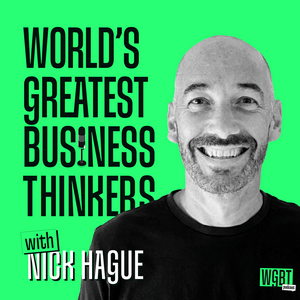
Nick Hague interviews world-renowned business experts from a range of disciplines to discuss their favourite strategies, models, frameworks, and their latest book releases on how to achieve business success.
Sitio web del podcast

Escucha World's Greatest Business Thinkers, Cracks Podcast con Oso Trava y muchos más podcasts de todo el mundo con la aplicación de radio.net

Descarga la app gratuita: radio.net

  • Añadir radios y podcasts a favoritos
  • Transmisión por Wi-Fi y Bluetooth
  • Carplay & Android Auto compatible
  • Muchas otras funciones de la app
Aplicaciones
Redes sociales
v8.3.1 | © 2007-2026 radio.de GmbH
Generated: 1/29/2026 - 6:03:45 AM