
Escucha gratis este podcast en la aplicación: Descarga gratuita en la App Store
radio.net
Sleep timer
Favoritos
60 episodios
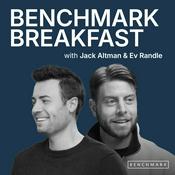
Benchmark Breakfast #2 | November 12, 2026
12/11/2026 | 1 h 2 minLet them eat pancakes! Jack and Ev give updates on the Anthropic IPO: the initial price range, the amended S-1 showing $81B run rate at the end of October, and what it means for how the stock actually trades. They get into the Jensen Huang spy allegations, what it costs the open source ecosystem if Nvidia’s most important advocate goes quiet, and why American open source just became a lot more strategically critical. They run through the AI trade unwind, the CapEx math behind it, and why the revenues from the AI ecosystem aren’t yet big enough to justify the buildout being contemplated. From the midterms: a Gallup poll showing the US at 36% AI optimism against China’s 93%, the Amazon HQ2 role reversal, and what the Metis, Louisiana data center deal shows about how that relationship can actually work. They close on the $60B VC fundraising wave hitting in the next 1–4 months from firms that raised just 12 months ago, reflexivity in private markets and why seed valuations may never fully reset, and what Sequoia’s restructure is really signaling about firm identity.
Timestamps:
(0:00) Intro
(0:42) Anthropic IPO pricing
(2:02) S-1 amended: $81B run rate
(4:08) Zooming out without Twitter
(5:10) Ev’s IPO prediction
(8:37) Structural volatility of AI labs
(10:31) Jensen Huang and the spy allegations
(13:22) Commoditize your complement
(15:31) Winners and losers from the Jensen news
(18:28) AI trade pulls back
(21:37) 70GW to 40–50GW
(23:00) Buyers of tokens and diffusion
(29:02) The RSI unlock
(30:37) Midterms: Democratic sweep
(31:47) America hates AI and data centers
(35:35) Amazon HQ2 role reversal
(38:13) Gallup poll: China vs. US on AI
(41:28) $60B in VC in the next 1–4 months
(43:08) Mega funds squeezing mid-size funds
(45:49) Reflexivity and the traffic wave
(51:03) Seeds are permanently expensive
(56:16) Sequoia’s restructure
(1:01:11) Product recs: Tesla YL and iPhone Duo
Links:
https://x.com/jaltma
https://x.com/everettrandle
https://www.citriniresearch.com/p/state-of-the-themes-556
https://news.gallup.com/poll/714593/optimism-globally-widespread-despite-uneven.aspx
friends@uncappedpod.comBenchmark Breakfast #1 | Jack and Ev
29/10/2026 | 55 minBenchmark Breakfast is a recurring conversation between Benchmark partners Jack Altman and Ev Randle. It’s a window into the firm’s Monday no-agenda partner meetings, where five partners sit around and talk about whatever came up that week.
In this inaugural episode, Jack and Ev dig into the Anthropic S-1: what the revenue-to-compute chart actually shows, why growth volatility and consumption-based revenue complicate the public market story, and whether code gen is the most impactful PMF moment in the history of technology. They steelman open source vs. closed source, run the numbers on what the inference cloud market actually looks like, and get into AI’s emerging cybersecurity threat — including “abliterated models,” open-weight models with safeguards removed that adversaries are already using. They close on why bio and robotics may ultimately matter more than all the software gains combined, and what Manhattan Project-scale investment in the physical world could actually unlock.
TIMESTAMPS:
(0:00) Intro
(0:45) Introducing Benchmark Breakfast
(2:09) Anthropic S-1 drops
(3:59) The revenue vs. compute chart
(6:19) Growth volatility and consumption-based revenue
(7:11) The race for the best model
(10:21) Code gen saturation and software factories
(13:39) The AI-bottleneck trade
(17:39) Code gen as the most impactful PMF in history
(21:27) Durability is hard to call
(23:36) Investing in the trend vs. calling the next one
(26:09) Circular revenue vs. outside customers
(28:15) Open source vs. closed source steelman
(34:25) Own your intelligence
(36:29) Open source as a % of frontier spend
(40:52) AI and cybersecurity
(44:35) Abliterated models
(48:08) Bio, robotics, and physical abundance
(51:52) Why physical feedback loops are slower
(54:12) Ev’s dad and the promise of bio
(55:13) Halloween plans and the iPhone Duo
LINKS:
https://x.com/jaltma
https://x.com/everettrandleUncapped #58 | David George from a16z
01/10/2026 | 53 minDavid George is a General Partner at Andreessen Horowitz, where he leads the firm's growth fund. Before a16z, David was a General Partner at General Atlantic. He has been involved in investments including Databricks, Ramp, Harvey, and Figma.
We discussed David's framework for thinking about the AI buildout: why the thesis that "it's all going to work" is the right one, and why the answer to almost every question in AI right now is "and" rather than "or." We got into where we actually are in the diffusion of AI into the enterprise, why there are 1.5 billion knowledge workers that AI has barely touched, and what would have to be true for the buildout not to continue. David shared his framework for thinking about product cycles vs. capital cycles, why right now is a 9 or 10 out of 10 on the product side, and why autonomous driving and robotics are massively underappreciated. We also talked about why vibes and narrative matter more than ever for founders, why he never shorts a messianic founder or a product people love, and how he thinks about the scale and ambition of Andreessen Horowitz as a firm.
Timestamps:
(0:00) Intro
(0:23) The answer to every AI question is "and"
(1:27) Where we are in the AI buildout
(4:55) What would stop the token buildout
(7:16) Sellers vs. buyers of tokens
(10:39) Frontier labs vs. open source
(13:18) Application investing and the coding blast radius
(14:01) Harvey and legal as a category
(20:46) Consumer AI and where we are
(22:14) From reactive to proactive AI
(25:52) AI, autonomy, robotics, bio health
(27:49) Autonomous driving and why it's underappreciated
(30:46) Robotics and what comes next
(33:25) Benchmark's new growth fund
(34:11) Why growth investing is compelling now
(34:53) Half of private market returns happen at growth
(37:57) Product cycle vs. capital cycle
(41:54) The importance of narrative
(43:14) Why vibes matter
(46:20) Never short a messianic founder
(49:39) How big can Andreessen Horowitz get
Links:
https://x.com/DavidGeorge83
https://x.com/jaltma
https://uncappedpod.com/
friends@uncappedpod.comUncapped #57 | Andrew Feldman from Cerebras
15/09/2026 | 1 h 2 minAndrew Feldman is the co-founder and CEO of Cerebras Systems, the AI chip company he founded in 2016 around a single radical insight: that winning in compute requires not incremental improvement but a fundamentally different architecture. Cerebras is the creator of the world's largest chip, the Wafer Scale Engine, and counts the US government, sovereign cloud providers, and OpenAI among its customers.
Alongside Eric Vishria from Benchmark, we discussed why Andrew believes that if you are going to attack Goliath, being 10% or even twice as good is not an available strategy and you have to aim for 100x or 500x better. Andrew walked through Cerebras's near-death experience: 18 months of board meetings where the only thing to report was "still can't make it," spending $8 million a month, and what kept the team going. He explained how we go from sand to a ChatGPT answer and why the US semiconductor supply chain is in a precarious position. Andrew shared what most people get wrong about what makes Nvidia great (it’s not CUDA), and why he thinks of himself as a professional David in an ongoing battle with Goliath.
Timestamps:
(0:00) Intro
(1:07) Why Andrew started Cerebras in 2016
(2:54) Eric on why he invested despite having no chip experience
(4:10) Attacking Goliath
(9:44) Near-death experiences and the Valley of Death
(10:44) 18 months of "still can't make it"
(12:16) Solving a 75-year-old compute problem
(13:26) What comes after Wafer Scale
(16:19) The chip supply chain explained
(22:30) Why the US punted a strategic industry
(25:51) How to be a good hardware board member
(27:50) Hardware vs. software investing
(29:05) The pivot from training to inference
(27:00) Specialization vs. flexibility
(35:22) Young product leaders and seasoned hardware engineers
(39:14) External relationships and TSMC
(42:20) The AI infrastructure buildout
(44:12) The data center supply chain
(53:14) Speed creates markets
(54:10) Disaggregation with AMD and AWS
(55:24) What actually makes Nvidia great
(57:30) Near-death experiences and the DNA of a Goliath fighter
(59:58) Andrew's childhood next to William Shockley
Links:
https://x.com/andrewdfeldman
https://x.com/cerebras
https://x.com/ericvishria
https://x.com/jaltma
https://uncappedpod.com/
friends@uncappedpod.comUncapped #56 | Brian Singerman from GPx
01/09/2026 | 1 h 2 minBrian Singerman is the co-founder of GPx, a fund launched in 2025 alongside Lee Linden of Quiet Capital. GPx backs elite emerging managers at the early stage, then provides programmatic capital to co-lead later-stage investments when those managers choose to bet their career on a breakout company. Before GPx, Brian was a General Partner at Founders Fund for over a decade, where he was involved in investments including Anduril, Stemcentrx, and Airbnb. He transitioned to Partner Emeritus at Founders Fund in December 2024.
We discussed Brian's framework for identifying outlier founders, why he has no checklist, no rubric, and no list of attributes, and why he is always looking for the single thing someone is genuinely better at than anyone else. Brian walked through the Anduril founding team as a case study in complementary spikes, explained what Peter Thiel is actually best at as a venture capitalist, and broke down how Founders Fund made the second most money on Airbnb despite being the 30th investor. We also got into GPx's strategy, why Brian thinks SPVs are dead, his framework for the optimal LP allocation to venture, and when to make a concentration bet.
Timestamps:
(0:00) Intro
(0:50) Why you can't have a checklist for founders
(1:46) How Brian looks for spikes
(3:55) How Founders Fund played to its strengths
(6:54) The Anduril founding team
(12:04) Shared beliefs as the foundation of company culture
(14:12) How Brian spent time with founders
(19:06) What Brian is genuinely best at
(20:25) GPx: backing elite emerging managers
(23:12) Why Brian knew he was done with traditional VC
(25:30) "I'm looking for people who could have beaten me in my prime"
(29:38) GPx's structure and the bet-your-career mechanism
(30:40) The optimal LP allocation to venture
(34:49) Why SPVs are dead
(41:00) How Founders Fund made the second most money on Airbnb
(43:51) The concentration strategy
(49:10) How Founders Fund worked and Peter's role
(52:16) What makes Peter Thiel the best venture capitalist in history
(56:53) Solo GPs vs. teams
(58:02) Brian's music studio
Links:
https://x.com/briansin
https://x.com/jaltma
https://uncappedpod.com/
friends@uncappedpod.com
Más podcasts de Tecnología



Podcasts a la moda de Tecnología
















Acerca de Uncapped | Benchmark Breakfast
Conversations with people we admire about things we’re genuinely interested in. Uncapped and Benchmark Breakfast live here.
Sitio web del podcastEscucha Uncapped | Benchmark Breakfast, The a16z Show y muchos más podcasts de todo el mundo con la aplicación de radio.net
Descarga la app gratuita: radio.net
- Añadir radios y podcasts a favoritos
- Transmisión por Wi-Fi y Bluetooth
- Carplay & Android Auto compatible
- Muchas otras funciones de la app

Uncapped | Benchmark Breakfast: Podcasts del grupo
 México

