

Escucha gratis este podcast en la aplicación: Descarga gratuita en la App Store
radio.net
Sleep timer
Favoritos
295 episodios
Why Batching is Slowing Your Team Down
18/08/2026 | 31 minWhat You'll Learn in This Episode:
In this episode of the Lean Solutions Podcast, Shayne Daughenbaugh and Andy Olrich welcome James Martin to explore why batching often feels more efficient, but can actually hurt the flow of an entire organization. James shares real-world examples of reducing batch sizes and moving toward flow, including a transformation that reduced processing time from 14 hours to as little as 1.5 hours while significantly increasing output.
The conversation explores how batching creates waiting, excess inventory, bottlenecks, and localized efficiency, and why teams need to focus on the flow of the entire system rather than individual productivity. James also explains how smaller batch sizes, experimentation, visual management, and employee empowerment can help organizations identify problems more quickly and foster a culture of continuous improvement.
Whether you're trying to reduce waste, improve manufacturing flow, or build a stronger continuous improvement culture, this episode offers practical examples of how reducing batching can help work move faster and more effectively through an organization.
Key Takeaways:
Focus on flow—not localized efficiency
Smaller batches can expose and eliminate waste
Make bottlenecks and problems visible
Empower teams to experiment and improve
Links:
https://www.linkedin.com/in/james-martin-4a4629254/
https://srasolutions.com.au/
https://www.findleansolutions.com/lean-summit/
https://www.findleansolutions.com/People + Innovation: A Pre-Summit Series
11/08/2026 | 25 minWhat You'll Learn in This Episode:
In this episode, Patrick Adams is joined by Rebecca Moyers, Director of Operational Excellence for the State of Missouri, for a preview of her session at the Lean Solutions Summit, The Feedback Advantage. Rebecca shares how the State of Missouri is using employee and customer feedback to guide process improvement, strengthen experiences, and focus limited resources on the improvements that matter most.
The conversation explores how Missouri built an operational excellence community across 17 executive agencies, uses feedback to support both employee and customer experience, and applies omni-channel listening to better understand the entire customer journey. Rebecca also explains why organizations need to look beyond internal silos and consider whether every part of an experience connects seamlessly from the customer's perspective.
Rebecca shares practical examples of collecting feedback through website interactions, surveys, call centers, and operational data, and emphasizes that organizations shouldn't ask for feedback unless they're prepared to act on it. Most importantly, she explains that these principles aren't limited to government or large organizations; teams in virtually any industry can use intentional feedback to improve processes, culture, and the experiences they create.
Key Takeaways:
Feedback helps organizations focus improvement efforts on what matters most
Great customer experiences require looking at the entire journey—not individual silos
Employee and customer feedback become more powerful when paired with operational data
Don't ask for feedback unless you're prepared to act on it
Links:
https://www.findleansolutions.com/lean-summit/
https://www.findleansolutions.com/People + Innovation: A Pre-Summit Series
04/08/2026 | 35 minWhat You'll Learn in This Episode:
In this episode, Patrick Adams is joined by Paul Doyle and Shawna Hondorp for a preview of their sessions at the Lean Solutions Summit. Together, they explore two critical topics shaping today's organizations: developing leaders through intentional systems and using AI to strengthen talent acquisition without losing the human connection.
The conversation dives into why leadership development should be treated as a business process rather than a training program, how specific leadership behaviors can be standardized and developed across every level of an organization, and why AI works best when paired with a thoughtful strategy. Shawna also shares practical insights into using AI responsibly in recruiting, emphasizing transparency, compliance, and the importance of maintaining authentic human relationships throughout the hiring process.
Whether you're leading a team, developing future leaders, building an AI strategy, or improving your hiring process, this episode provides practical insights for creating stronger leaders, smarter systems, and more intentional organizations.
Key Takeaways:
Leadership development is a business process—not just a training program
Strong leadership is built through intentional behaviors and systems
AI should enhance human connection, not replace it
A successful AI strategy requires intentionality, transparency, and trust
Links:
https://www.findleansolutions.com/
https://www.findleansolutions.com/lean-summit/How to Find the Real Root Cause
28/07/2026 | 33 minWhat You'll Learn in This Episode:
In this episode, Shayne Daughenbaugh sits down with Seamus Maguire to explore one of the biggest reasons problem-solving fails, even in organizations with experienced people and proven Lean tools. Drawing from his new book, Finding Fact Before Fixing, Seamus explains how cognitive biases, assumptions, and the pressure to find quick answers often lead teams to solve the wrong problem.
The conversation explores why hypothesis testing and experimentation should be at the center of every problem-solving effort, how leaders can ask better questions to uncover true root causes, and why collecting the right data is more important than simply collecting more data. Seamus also shares practical ways to challenge assumptions, use the scientific method in everyday problem-solving, and create a culture where teams focus on finding facts before implementing fixes.
Key Takeaways:
Challenge assumptions before finding solutions
Use hypothesis testing instead of educated guesses
Ask better questions to uncover root causes
Collect the right data—not just more data
Links:
linkedin.com/in/seamusmaguire?utm_source=share_via&utm_content=profile&utm_medium=member_ios
https://www.routledge.com/Finding-Fact-Before-Fixing-How-Business-Professionals-Can-Avoid-False-Assumptions-When-Solving-Problems/Maguire/p/book/9781041130307
https://www.findleansolutions.com/
https://www.findleansolutions.com/lean-summit/People + Innovation: A Pre-Summit Series
21/07/2026 | 38 minWhat You'll Learn in This Episode:
In this episode, Patrick Adams is joined by Brett Lesiewicz, Judd VanBergen, and Phil Ranck for a preview of their sessions at the 2026 Lean Solutions Summit. Together, they explore how stronger relationships, proactive planning, and better communication help organizations succeed in uncertain environments.
The conversation highlights how Lean tools like the Last Planner System, takt planning, and visual management are transforming the construction industry by creating alignment, improving collaboration, and reducing uncertainty before work even begins. Phil also introduces the Seven Thinking Gears, a structured communication framework designed to make meetings more productive, uncover innovative ideas, and empower every team member to contribute to continuous improvement.
Whether you're in construction, manufacturing, healthcare, or another industry, this episode offers practical insights into building stronger teams, improving communication, and creating more predictable results through Lean thinking.
Key Takeaways:
1. Strong relationships create certainty in uncertain environments
2. Proactive planning prevents costly rework
3. Better communication unlocks innovation
4. Lean principles apply far beyond manufacturing
Links:
https://www.findleansolutions.com/
https://www.findleansolutions.com/lean-summit/
Más podcasts de Administración
 WhitepaperAdministración, Economía y empresa, Empresa, Inversión
 HBR IdeaCastAdministración, Economía y empresa, Empresa, Marketing
 Coaching for LeadersAdministración, Carrera, Economía y empresa, Educación, Superación personal
 Leadership Without Losing Your Soul: Master Communication & Management Skills To Boost Productivity, Teamwork & Ease OverwhelmAdministración, Economía y empresa
 El Podcast de Xavier MarcetAdministración, Economía y empresa, Educación, Superación personal
 Business WarsAdministración, Economía y empresa, Historia
 LIDERAZGO INCÓMODO con Mario ElsnerAdministración, Carrera, Economía y empresa, Empresa
Podcasts a la moda de Administración
- Leadership Without Losing Your Soul: Master Communication & Management Skills To Boost Productivity, Teamwork & Ease OverwhelmAdministración, Economía y empresa
 The Learning Leader Show With Ryan HawkAdministración, Carrera, Economía y empresa
 Mejorando la Calidad de Vida del Director GeneralAdministración, Economía y empresa, Educación
 Coaching Real LeadersAdministración, Carrera, Cultura y sociedad, Economía y empresa
 Inside the Strategy RoomAdministración, Economía y empresa, Noticias, Noticias financieras
 Trade Finance TalksAdministración, Economía y empresa, Noticias, Noticias financieras
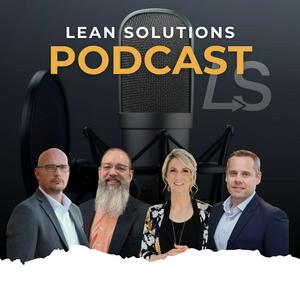
Acerca de The Lean Solutions Podcast
This podcast offers business solutions to help listeners develop and implement action plans for lean process improvement and implement continuous improvement projects, cost reductions, product quality enhancements, and process effectiveness improvement. Listeners come from many industries in both manufacturing and office applications.
Sitio web del podcastEscucha The Lean Solutions Podcast, Whitepaper y muchos más podcasts de todo el mundo con la aplicación de radio.net
Descarga la app gratuita: radio.net
- Añadir radios y podcasts a favoritos
- Transmisión por Wi-Fi y Bluetooth
- Carplay & Android Auto compatible
- Muchas otras funciones de la app
Descarga la app gratuita: radio.net
- Añadir radios y podcasts a favoritos
- Transmisión por Wi-Fi y Bluetooth
- Carplay & Android Auto compatible
- Muchas otras funciones de la app

The Lean Solutions Podcast
Escanea el código,
Descarga la app,
Escucha.
Descarga la app,
Escucha.
The Lean Solutions Podcast: Podcasts del grupo
 México