

Escucha gratis este podcast en la aplicación: Descarga gratuita en la App Store
radio.net
Sleep timer
Favoritos
65 episodios
Leon Trotsky: The Last Prophet | Part 3 | Ancient to Recent | Episode 63
15/08/2026 | 43 minTrotsky has lost his struggle with Stalin for leadership of the Soviet Union
But his revolutionary fire still burns bright.
The man who helped seize power and build the Red Army is now a political exile, hunted by the regime he helped create.
In this third episode, we follow Trotsky from exile in Kazakhstan to Turkey, France and Norway as Stalin's campaign against his former rival intensifies.
We explore Trotsky's bitter confrontation with the liberal democracies that refused him entry, the contradiction between his demands for political freedom and his own defence of revolutionary dictatorship, and his growing isolation from the Communist movement.
But Stalin's vengeance reaches far beyond Trotsky himself.
As the Moscow Trials and Great Terror begin, Trotsky watches helplessly as his supporters, friends and family are arrested, imprisoned and executed. His name becomes the centrepiece of Stalin's vast conspiracy theory.
Finally, Norway withdraws its protection and Trotsky is forced to leave Europe.
Across the Atlantic, an unlikely refuge awaits.
Mexico.
But as Trotsky sails towards his new home, Stalin's most dangerous enemy is about to enter the final and most terrifying chapter of his life.
Can Trotsky survive when the full power of the Soviet state is determined to destroy him?
🎧 New episodes every Saturday
📲 YouTube, Spotify & Apple Podcasts | @AncientToRecent
#Trotsky #RussianRevolution #HistoryPodcast #SovietHistory #Stalin #GreatTerror #MoscowTrials #Trotskyism #RussianHistory #HistoryDocumentaryLeon Trotsky: The Last Prophet | Part 2 | Ancient to Recent | Episode 62
08/08/2026 | 44 minLeon Trotsky has helped seize power, built the Red Army, and defeated the enemies of the Bolshevik Revolution.
Now he is about to lose everything.
By 1927, the man who had once stood beside Lenin at the centre of the Russian Revolution has been transformed from revolutionary hero into Stalin's most dangerous political rival.
In this second episode of our series, we follow Trotsky through the Russian Civil War and the violent birth of the Soviet state, as he attempts to save the revolution he helped create.
We explore the Bolshevik seizure of power, the dissolution of the Constituent Assembly, the creation of the Cheka, and the brutal campaign of terror unleashed against the revolution's enemies.
We examine the Treaty of Brest-Litovsk, where Trotsky's vision of worldwide revolution collided with Lenin's determination to preserve the fragile Soviet state.
As Russia descends into civil war, Trotsky transforms himself from revolutionary intellectual into military commander.
Travelling across the country aboard his famous armoured train, he builds the Red Army, recruits former Tsarist officers, imposes ruthless discipline, and helps turn the tide against the White armies.
But victory comes at an enormous cost.
The episode also examines the Kronstadt Rebellion of 1921, when sailors who had once been celebrated as heroes of the Revolution rose against Bolshevik rule. Trotsky and Lenin responded with force, crushing the uprising and revealing just how far the revolution had travelled from the ideals of 1917.
Then, with the Civil War over and Lenin dying, a new struggle begins.
Joseph Stalin is quietly building a network of loyal supporters throughout the Communist Party, while Trotsky assumes that his revolutionary reputation and intellectual brilliance will make him Lenin's natural successor.
It is a fatal mistake.
As Lenin's death approaches, Stalin steadily isolates his rival. Trotsky loses influence, his supporters are removed, and his role in the Revolution and Civil War is increasingly rewritten.
By the Fifteenth Party Congress in 1927, the outcome is no longer in doubt.
Trotsky is expelled from the Communist Party, arrested by the Soviet secret police, and sent into exile in Kazakhstan.
How did the revolutionary who helped create the Soviet state become its most famous exile?
Why did Trotsky underestimate Stalin so catastrophically?
And how did the man who helped build the Red Army become the greatest political enemy of the man who would eventually rule the Soviet Union?
Join Joseph Parkinson as Ancient to Recent continues the extraordinary story of Leon Trotsky, the revolutionary who helped make the Soviet Union, only to find himself hunted by the regime he had helped create.
🎧 New episodes every Saturday
📲 YouTube, Spotify & Apple Podcasts | @AncientToRecent
#Trotsky #RussianRevolution #HistoryPodcast #SovietHistory #RussianHistory #Stalin #LeninLeon Trotsky: The Last Prophet | Part 1 | Ancient to Recent | Episode 61
01/08/2026 | 41 minOne of history's greatest revolutionaries awaits his assassination.
As Leon Trotsky sits inside his heavily guarded villa in Mexico City, he knows that Joseph Stalin has not forgotten him.
Once hailed as Lenin's brilliant lieutenant and commander of the Red Army, Trotsky has become the Soviet dictator's most dangerous enemy. His extraordinary journey began decades earlier on the vast plains of the Russian Empire.
In this opening episode of our new series, we trace Trotsky's life from his childhood as Lev Bronstein on the Ukrainian steppe to his transformation into one of the most influential revolutionaries of the twentieth century.
We explore the world of the Romanov Empire, the reforms of Alexander II, the rise of industrialisation, and the social tensions that pushed millions towards radical political ideas.
As Russia hurtles towards crisis, the young Trotsky embraces Marxism, endures imprisonment and exile in Siberia, escapes to Western Europe, and encounters Vladimir Lenin for the first time.
The episode also examines the failed Revolution of 1905, the growing divisions within the socialist movement, Trotsky's first meeting with the little-known revolutionary Joseph Stalin, and the outbreak of the First World War, which would bring the Romanov dynasty to the brink of collapse.
How did the son of a prosperous farmer become history's most famous revolutionary exile?
Why did Trotsky believe that only revolution could save Russia?
And how did the First World War create the conditions that would transform both Trotsky and the twentieth century?
Join Joseph Parkinson as Ancient to Recent begins the extraordinary story of Leon Trotsky, the revolutionary who helped change the world before becoming the greatest enemy of Joseph Stalin.
🎧 New episodes every Saturday
📲 YouTube, Spotify & Apple Podcasts | @AncientToRecent
#Trotsky #RussianRevolution #HistoryPodcast #SovietHistory #RussianHistory #Stalin #Lenin500 Men vs an Empire: Hernán Cortés and the Conquest of Mexico | Part 4 | Ancient to Recent | Episode 60
25/07/2026 | 48 minThe conquest reaches its devastating conclusion.
As Hernán Cortés launches his final assault on Tenochtitlan, one of the greatest cities on earth becomes the scene of one of history's most brutal sieges.
Thirteen brigantines dominate the waters of Lake Texcoco, while tens of thousands of Spanish and indigenous allies advance along the great causeways. Street by street, canal by canal, the fate of the Mexica Empire hangs in the balance.
This episode explores the final months of the siege of Tenochtitlan, where starvation, disease and relentless warfare reduce a magnificent civilisation to ruins.
Despite overwhelming odds, Emperor Cuauhtémoc and the Mexica fight with extraordinary courage, refusing every offer of surrender as the city is systematically destroyed around them.
But the story does not end with military victory.
Following the fall of Tenochtitlan, we examine how New Spain was built upon its ashes.
As missionaries sought to convert millions to Christianity, indigenous communities adapted, resisted and reshaped the new colonial world in ways that continue to influence Mexico today.
We also follow Hernán Cortés after his greatest triumph, as political rivals, royal officials and the Spanish Crown gradually stripped the conqueror of the power he had fought so hard to obtain.
Was the conquest truly won by 500 Spaniards alone?
How much did indigenous allies determine the outcome of the war?
And what lasting legacy did the fall of the Mexica Empire leave for Mexico, Spain and the modern world?
Join Joseph Parkinson as Ancient to Recent concludes the extraordinary story of Hernán Cortés and the conquest of Mexico.
🎧 New episodes every Saturday
📲 YouTube, Spotify & Apple Podcasts | @AncientToRecent
#HernanCortes #ConquestOfMexico #AztecEmpire #Tenochtitlan #Cuauhtemoc #HistoryPodcast #Conquistadors #MexicanHistory500 Men vs an Empire: Hernán Cortés and the Conquest of Mexico | Part 3 | Ancient to Recent | Episode 59
18/07/2026 | 40 minThe splendour of Tenochtitlan soon gives way to horror.
As the Spaniards settle into the heart of the Mexica capital, they are overwhelmed by its wealth, its markets and its astonishing organisation. Yet beneath the city's beauty lies an uneasy calm. Surrounded by tens of thousands of warriors, Cortés knows one wrong move could mean annihilation.
This episode explores the fragile relationship between Hernán Cortés and Emperor Moctezuma II as diplomacy slowly gives way to suspicion, violence and betrayal.
After taking Moctezuma prisoner in one of history's boldest political gambles, the Spaniards find themselves increasingly isolated. Religious tensions deepen, human sacrifice horrifies the Europeans, and the arrival of a rival Spanish expedition threatens to destroy Cortés's entire enterprise.
While Cortés marches to confront his enemies on the coast, disaster strikes in Tenochtitlan. A massacre during a sacred Mexica festival ignites a full-scale uprising, trapping the Spaniards inside the city and bringing the conquest to the brink of collapse.
Could Cortés still control events from afar?
Did Moctezuma truly lose the loyalty of his own people, or has history accepted the Spanish version too readily?
And when the conquistadors attempt to flee the city under cover of darkness, will any of them escape alive?
Join Joseph Parkinson as Ancient to Recent continues the extraordinary story of Hernán Cortés and the conquest of Mexico.
🎧 New episodes every Saturday
📲 YouTube, Spotify & Apple Podcasts | @AncientToRecent
#HernanCortes #ConquestOfMexico #AztecEmpire #Tenochtitlan #Moctezuma #LaNocheTriste #HistoryPodcast #Conquistadors
Más podcasts de Historia
 Teorías de ConspiraciónCultura y sociedad, Documental, Historia
 Escándalo MexicanoCultura y sociedad, Historia
 Historia para Tontos PodcastHistoria
 Curiosidades de la Historia National GeographicHistoria
 Historia en PodcastHistoria
 DESPIERTA TU CURIOSIDADCiencias, Cultura y sociedad, Historia
 The Rest Is HistoryHistoria
 Relatos de la HistoriaHistoria
 DramaMex: Historias que merecen ser escuchadasCultura y sociedad, Historia, True crime
Podcasts a la moda de Historia
 American Revolution PodcastEducación, Historia
 SerialMente | Asesinos en SerieCultura y sociedad, Documental, Historia, True crime
 Provoked with Darryl Cooper and Scott HortonHistoria, Noticias, Política
 HisteriadoresHistoria
 Conflicted: A History PodcastCultura y sociedad, Educación, Historia
 Vida Corriente en la Edad MediaHistoria
 Leyendas e Historias de Terror: La Habitación de MéxicoFicción, Historia, True crime
 History of the Second World WarCultura y sociedad, Documental, Historia
 Imagen por la HistoriaHistoria
 História em Meia HoraHistoria
Acerca de Ancient to Recent
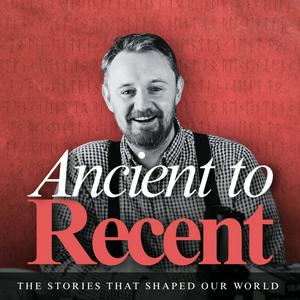
Ancient to Recent is a history podcast that explores how the past continues to shape our world today. From forgotten empires and overlooked revolutions to the hidden lives of historical figures, each episode takes a deep dive into the moments that mattered and the ones that should have.
🎙️ New episodes every week
📚 Based on real historical research and books
🌍 Covering everything from ancient civilisations to modern events
Whether you're a casual history fan or a dedicated learner, Ancient to Recent brings you the stories that shaped the world
Sitio web del podcastEscucha Ancient to Recent, Teorías de Conspiración y muchos más podcasts de todo el mundo con la aplicación de radio.net
Descarga la app gratuita: radio.net
- Añadir radios y podcasts a favoritos
- Transmisión por Wi-Fi y Bluetooth
- Carplay & Android Auto compatible
- Muchas otras funciones de la app
Descarga la app gratuita: radio.net
- Añadir radios y podcasts a favoritos
- Transmisión por Wi-Fi y Bluetooth
- Carplay & Android Auto compatible
- Muchas otras funciones de la app

Ancient to Recent
Escanea el código,
Descarga la app,
Escucha.
Descarga la app,
Escucha.
 México