

Escucha gratis este podcast en la aplicación: Descarga gratuita en la App Store
radio.net
Sleep timer
Favoritos
283 episodios
150: Julian Jaynes, Part 1 - Hearing Voices
22/09/2026 | 1 h 25 minWhat is consciousness? Julian Jaynes rejects all of the popular answers: that consciousness is thinking, reason, memory, or the capacity for learning. Nor does he think it can be accounted for as a merely accumulative development of "sentience" through evolution. In his controversial work, Origins of Consciousness in the Breakdown of the Bicameral Mind, Jaynes puts forward the hypothesis that consciousness is generated out of language, and therefore that language predates consciousness. Jaynes' argument has sweeping implications for human history and civilization, and he presents evidence for his case through psychological experiments on consciousness, the neurology of schizophrenia, and through the analysis of ancient texts such as the Iliad of Homer. The shocking claim made in this book is that the Greeks of the Iliad were not conscious in the way that we are, but experienced their volition in the form of admonitory voices - actually, a communication from the right hemisphere of the brain to the left, using language as a kind of code - but which the ancients experienced as the voices of gods.149: The Laṅkāvatāra Sutra
15/09/2026 | 1 h 55 minIn this episode, we're going to discuss what is likely the founding text of the Zen tradition, the Laṅkāvatāra Sutra. According to some of the earliest sources on Bodhidharma, the founder of Zen in China, the "Lanka" was the teaching whose "abstruse principle" he passed down to his successor, Huike. Within the same story, Huike laments that within only a few generations, the sutra will pass into obscurity - which is exactly what has happened. Though few read this text today, during my time in Zen, I found the Lanka's philosophical presentation of the "mind only" teaching to be uniquely intriguing among all the Buddhist scriptures I'd read. Join me on this exploration of the Buddha's teaching in Lanka, including an analysis of the eight consciousness model of the mind, the concept of paravrrti, the non-reliance on either existence or non-existence, and sublime teaching that the world is nothing other than mind.
My Diagram:
https://untimely-reflections.blogspot.com/2026/09/lankavatara-sutra-my-diagram-of-eight.html148: Keiji Nishitani - Religion and Nothingness, part 2
08/09/2026 | 1 h 25 minThis episode begins with an analysis of Baizhang's wild fox koan found in the Wumenguan, which we will use as a jumping off point for understanding the paradoxical relationship of the enlightened person with karma. This opens up into the general problem of discussing reality from the perspective of sunyata, in which samsara and nirvana become equivalent - because, so long as one approaches from the perspective of conceptual thought, they will remain forever unequivalent, and all such statements will be false or misleading. Join me as we discuss karma, the bodhisattva vow, "plucking out the eye of Buddha and sitting in its hollow", the meaning of "just sitting" in zazen, and the time when St. Francis made the sign of the cross to a cauterizing iron and blessed his brother, fire.147: Keiji Nishitani - Religion & Nothingness, part 1
02/09/2026 | 1 h 46 minUPDATE: I accidentally uploaded part two to Spotify instead of part one. This has been fixed. To those who got to listen to the entire two-parter already already, lucky! But, the audio should now be part one.
Join me for a deep dive into Nishitani's opus, Religion and Nothingness: an intersection of philosophy and religion, east and west, Heidegger and the Mahayana. The topics I choose to emphasize in my reading are: the "double exposure" whereby the two layers of reality (being and nihility) are simultaneously perceived; the mechanization of the world, which serves to objectify the scientific worldview; Nietzsche's answer to this problem, as Nishitani understands it; the religious quest, in which one pushes through nihility, subsuming their entire life and body within the "great doubt"; finally, the standpoint of sunyata in which emptiness is perceived as the ground of being.146: Extinction (Nietzsche vs Buddhism, pt. 2)
25/08/2026 | 1 h 39 minFor all that is admirable in Buddhism, Nietzsche fundamentally opposes the movement towards the Last Man that Buddhism not only cannot oppose, but may even help bring forth. Why does the notion of a "European Buddhism" haunt Nietzsche's later writings? We will explore this question here: how a religion that is realistic, empirical, and achieves great practical success in the relief of suffering isnevertheless inevitably aimed at uprooting all action and delivering man to a state of passivity. Here we find another religion of pity, and another denial of the world - merely deprived of the sensualism and moral fanaticism of Christianity. Were such a religion to take hold in the West, Nietzsche believes, the opportunity of moment, which we face as a consequence of the death of God, would be squandered. Join me in exploring more sutras, as well Nietzsche's criticisms of Buddhism in The Gay Science, Daybreak, Beyond Good and Evil, and the Will to Power.
Más podcasts de Cultura y sociedad
 ROCA PROJECTCultura y sociedad
 The Wild ProjectCultura y sociedad, Humor, Noticias, Noticias de entretenimiento
 Se Regalan DudasCultura y sociedad, Relaciones, Salud y forma física
 Relatos Forenses PodcastCultura y sociedad, Documental
 pepe&chema podcastCultura y sociedad, Documental
 Más Allá del RosaCultura y sociedad, Diarios personales, Documental
 Seminario Fenix | Brian TracyCultura y sociedad, Economía y empresa, Educación, Empresa, Filosofía, Superación personal
 De Todo Un MuchoCultura y sociedad, Espiritualidad, Humor, Relaciones, Religión y espiritualidad
 PenitenciaCultura y sociedad, True crime
 La Pinche Complejidad con Nicolás AlvaradoCultura y sociedad, Noticias, Política
Podcasts a la moda de Cultura y sociedad
 The InterviewCultura y sociedad, Noticias
 Iker UnzuCultura y sociedad, Diarios personales
 The Wirecutter ShowCultura y sociedad, Educación, Hogar y jardín, Ocio, Tutoriales
 Dear Hank & JohnCultura y sociedad, Educación, Filosofía, Humor, Improvisación, Superación personal
 La Fucking Condición HumanaCultura y sociedad, Diarios personales, Documental
 El podcast de Celia | Terapia de parejaCultura y sociedad, Educación, Relaciones, Salud mental, Salud y forma física, Sexualidad, Superación personal
 Bocaranda ShowCultura y sociedad
 Punzadas SonorasCultura y sociedad, Filosofía
 Ponchote PodcastArte, Cultura y sociedad, Diarios personales, Libros, Lugares y viajes
 CriminalCultura y sociedad, Documental, True crime
 Guten Tag AlemaniaCultura y sociedad, Lugares y viajes
 The Oprah PodcastCultura y sociedad
 Sounds Like A CultCultura y sociedad, Educación, Religión y espiritualidad
 El Show De PiolínCultura y sociedad, Humor
 Las RarasCultura y sociedad, Documental
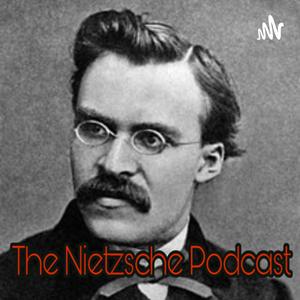
Acerca de The Nietzsche Podcast
A podcast about Nietzsche's ideas, his influences, and those he influenced. Philosophy and cultural commentary through a Nietzschean lens.
Support the show at Patreon: https://www.patreon.com/untimelyreflections
A few collected essays and thoughts: https://untimely-reflections.blogspot.com/
Sitio web del podcastEscucha The Nietzsche Podcast, ROCA PROJECT y muchos más podcasts de todo el mundo con la aplicación de radio.net
Descarga la app gratuita: radio.net
- Añadir radios y podcasts a favoritos
- Transmisión por Wi-Fi y Bluetooth
- Carplay & Android Auto compatible
- Muchas otras funciones de la app
Descarga la app gratuita: radio.net
- Añadir radios y podcasts a favoritos
- Transmisión por Wi-Fi y Bluetooth
- Carplay & Android Auto compatible
- Muchas otras funciones de la app

The Nietzsche Podcast
Escanea el código,
Descarga la app,
Escucha.
Descarga la app,
Escucha.
 México