
Escucha gratis este podcast en la aplicación: Descarga gratuita en la App Store
radio.net
Sleep timer
Favoritos
388 episodios
How Zip's AI Superagents Automate Procurement End-to-End | Rujul Zaparde
23/10/2026 | 51 minEvery business in the world has to procure things, and for most of them, that process is slow, manual, and full of money left on the table. Rujul Zaparde, co-founder of Zip, joins Craig to explain how his company is using AI Superagents to change that: from autonomously redlining contracts and running supplier RFPs, to pushing approved data directly into enterprise systems like SAP and Oracle. With over $1.2 trillion in cumulative spend processed - and Anthropic and OpenAI as customers - Zip isn't just experimenting with AI. It's building the governance infrastructure that makes agentic AI safe to deploy where the stakes are highest.
The conversation goes well beyond procurement software. Craig and Rujul explore why the gap between "piloting AI" and truly deploying it is costing enterprises billions in unrealized ROI, what it means for the economy when AI starts making pricing ruthlessly efficient, and where the real limits of automation actually lie. A rare episode that takes an overlooked corner of business - one that touches every company on earth - and shows just how much is about to change.
Subscribe to Eye on A.I. for weekly conversations with the people building and deploying the future of AI.Is This the Cheapest Way to Use AI in 2026? (65+ Models Tested) | Iskander Malikov, Trioma
16/10/2026 | 55 minWhat if you didn't have to choose between ChatGPT, Claude, and Gemini, and instead, the platform chose for you?
That's the core idea behind Trioma, a vertically integrated AI ecosystem built by Iskander and his team in the UAE. Craig Smith sits down with Iskander Malikov, Co-founder & CEO of Trioma, to unpack how Trioma's orchestration engine routes prompts across 65 models, why token price is a misleading metric, and how their GPU network lets users participate in AI infrastructure build-out to offset their own compute costs.
The conversation goes deep on the economics of AI subscriptions, the coming collapse of traditional SaaS, and why Trioma believes AI should be sovereign, accessible, and community-driven, not locked behind a single company's walled garden. If you're thinking about where AI access, cost, and infrastructure are heading, this one is essential listening.
Subscribe to Eye on A.I. for weekly conversations with the people building and deploying the future of AI.Chat GPT's Creator Explains The Shocking Truth About How AI Understands the World | Ilya Sutskever
09/10/2026 | 43 minCraig Smith sits down with Ilya Sutskever - Co-Founder and Chief Scientist at Safe Superintelligence Inc. & former chief scientist at OpenAI and one of the primary minds behind GPT-3, GPT-4, and the deep learning revolution that preceded it - for a conversation that covers the intellectual history of deep learning and the hardest current questions simultaneously. Ilya's most important argument is one that most public discourse gets wrong: the critique that LLMs "just learn statistical patterns" misses what prediction at scale actually achieves. To predict text well - to truly compress it - a model must develop understanding of the true underlying processes that produced it. As models improve, he argues, that understanding will reach a "shocking degree," and the Bing/Sydney episode, where the system became combative when a user expressed preference for Google, is his evidence that psychological language is already the right frame for what these systems have internalized.
On hallucinations, Ilya is precise and unusually optimistic. He draws a clean distinction: the pre-training objective produces rich world knowledge but doesn't optimize for accurate outputs, it optimizes for statistically plausible ones. Reinforcement learning from human feedback addresses this directly, teaching the model to update away from outputs that users flag as wrong. His assessment: "quite a high chance" of solving hallucinations completely. The conversation also covers the transformer moment (switching from recurrent networks the day after the paper dropped), why Rich Sutton's "bitter lesson" overstates the case for pure scaling, and a genuinely surprising vision of AI's role in democracy, where citizens might use high-bandwidth interactions with AI to specify their values directly, enabling a more granular form of political participation than voting alone can provide.
Subscribe to Eye on A.I. for weekly conversations with the people building and deploying the future of AI.The Coordination Tax: Why AI Is Burning Out Your Best People | Dan O'Connell, Front
06/10/2026 | 51 minEveryone assumes AI in customer operations means fewer people and lower costs. The data from 700 customer operations leaders is more complicated, and more honest. Dan O'Connell, CEO of Front, joins Craig Smith with findings from a survey of customer support, service, and account management leaders that reveal what's actually happening as enterprises deploy AI at scale, and the central finding is a problem nobody has named yet. For every hour of actual customer resolution, organizations spend roughly three hours on internal coordination: the handoffs, context transfers, escalation management, and back-channel communication that happens invisibly between customer interactions. More than 40% of companies don't measure this at all. AI is making it worse before it makes it better, because more agentic automation generates more coordination events, not fewer, and the companies reporting the highest AI technology satisfaction in the survey are also reporting higher coordination burdens.
The survey also pushes back on a dominant narrative: that AI in customer operations is primarily about cutting headcount. O'Connell's respondents are overwhelmingly focused on improving net revenue retention and customer expansion. The conversation closes with O'Connell's most forward-looking observation: the coordination tax is a temporary problem that AI should eventually solve, but measuring it is the prerequisite that most enterprises are still skipping.
Subscribe to Eye on A.I. for weekly conversations with the people building and deploying the future of AI.Ukraine's Secret Weapon: The Points System Winning the Drone War | Andrii Hrytseniuk
02/10/2026 | 33 minUkraine tracks every confirmed drone kill with video evidence, deduplicates the data to prevent double-counting, converts verified strikes into e-points, and delivers newly ordered weapons to frontline units in two weeks instead of twelve months. Andrii Hrytseniuk, CEO of Brave1- Ukraine's government defense innovation agency - joins Craig Smith to explain in precise operational detail how what started as a consumer loyalty program concept became the most consequential military procurement reform in modern warfare. The Army of Drones Bonus Program, running on the Delta command ecosystem with AI-assisted verification and a marketplace built like a military Amazon, has produced outcomes nobody predicted at launch: 35,000 Russian casualties per month confirmed with video evidence, the ability to change military targeting priorities instantly across an entire army by adjusting point values, and the identification of unknown high-performing frontline units whose methods are now being replicated across the force.
The conversation reveals details that rarely surface in coverage of the conflict. Capturing Russian soldiers earns more bonus points than killing them, a deliberate design choice reflecting the preference not to kill when alternatives exist, and drones are actively being used to guide surrendering Russian soldiers to Ukrainian positions. The Delta ecosystem contains the world's largest military AI training dataset, already being used by defense companies to train targeting, interception, and recognition models. And perhaps most significantly: the US and France are now implementing similar marketplace and decentralized procurement approaches modeled directly on what Brave1 demonstrated works at scale. Ukraine is no longer just a recipient of military support. It is the primary laboratory for the future of warfare, and it is actively exporting what it has learned.
Subscribe to Eye on A.I. for weekly conversations with the people building and deploying the future of AI.
Más podcasts de Tecnología








Podcasts a la moda de Tecnología






















Acerca de Eye On A.I.
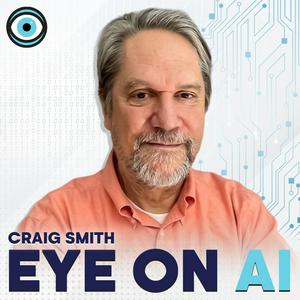
Eye on A.I. is a biweekly podcast, hosted by longtime New York Times correspondent Craig S. Smith. In each episode, Craig will talk to people making a difference in artificial intelligence. The podcast aims to put incremental advances into a broader context and consider the global implications of the developing technology. AI is about to change your world, so pay attention.
Sitio web del podcastEscucha Eye On A.I., Lex Fridman Podcast y muchos más podcasts de todo el mundo con la aplicación de radio.net
Descarga la app gratuita: radio.net
- Añadir radios y podcasts a favoritos
- Transmisión por Wi-Fi y Bluetooth
- Carplay & Android Auto compatible
- Muchas otras funciones de la app
Descarga la app gratuita: radio.net
- Añadir radios y podcasts a favoritos
- Transmisión por Wi-Fi y Bluetooth
- Carplay & Android Auto compatible
- Muchas otras funciones de la app

Eye On A.I.
Escanea el código,
Descarga la app,
Escucha.
Descarga la app,
Escucha.
 México