
Escucha gratis este podcast en la aplicación: Descarga gratuita en la App Store
radio.net
Sleep timer
Favoritos
29 episodios
Writing Wrongs Live! 2026: The Fraud Files
06/11/2026 | 1 h 3 min*Warning: This episode contains discussion of coercive communication and fraud including romance and investmentfraud. Listener discretion is advised.*
This special episode was recorded live with audience participation in the very atmospheric venue of West Midlands Police Museum at the Old Steelhouse Lane Lockup on 28th October 2026, as part of the ESRC Festival of Social Science.
Tim and Nicci are joined by two distinguished guests, Dr Elisabeth Carter from Kingston University London and Dr Rasha Kassem from Aston University, to examine three cases of romance and investment fraud. They discuss how linguistic expertise sheds light on the manipulative strategies employed by fraudsters, give advice on protecting ourselves and others from this threat, and answer insightful questions from our fantastic live audience.
If you enjoyed this episode, you can listen to our previous conversation with Dr Elisabeth Carter (S1 E4 Romance Fraud: The Linguistic Crime Scene), and last year’s live podcast episode (S2 E4 Writing Wrongs Live!).
Have a question for Nicci or Tim? Email us at writingwrongs@aston.ac.uk and we may answer it during an upcoming episode!
Check out the official AIFL blog for more forensic linguistic goodies here: https://medium.com/@AIFLblog
If you have been affected by any of the themes in thisweek’s episode, please contact one of these free sources:
Report Fraud: https://www.reportfraud.police.uk/
City of London Police resources on romance fraud and investment fraud
https://www.samaritans.org/how-we-can-help/contact-samaritan/
https://www.helpguide.org/find-help
Production Team: Jordan Robertson, NeusAlberich Buera, Karolina Placzynta, Noorin Iqbal, Amy Brown, Laurence Romain, Michaela Wolf, Maddie Clark, Daisy Etell, Ella Harman
Sound: Dave Ison, Premier Production
Editing: Angela Walker
Visual design: George Grant
Additional Voices: Kirsty Benson, Maddie Clark,Madison Hunter, Daisy Etell, Dana Roemling, Lauren Morgan, Helen Gilfoyle, Sophie Jones, Jon Darling.
Photo credits: Noorin Iqbal, Elisabeth Carter, TimGrant, Jordan Robertson, Amy Brown, Ella Harman, Daisy Etell, Laurence Romain.
With special thanks to the West Midlands Police Museum.
Dr Elisabeth Carter’s home page: ElisabethCarter – Kingston University London
Dr Rasha Kassem’s home page: Rasha Kassem –Aston Research Explorer
Professor Tim Grant’s home page: TimGrant – Aston Research Explorer
Dr Nicci MacLeod’s home page: Nicci MacLeod –Aston Research ExplorerLetters from Leeds
02/10/2026 | 41 min* Warning: Today’s episode contains discussions of threatening communication and blackmail*
Summer, 2011, Leeds, England. Two elderly residents of a housing estate are feeling terrorised after receiving hand delivered typed letters accusing them of wrongdoing and threatening harm unless they comply with a request for large sums of cash. The letters suggest that they are being watched on a daily basis, and warn them not to involve the police. They both do contact the police, who shortly identify and arresta suspect – local woman Judy Dunne. A warrant is issued to search Dunne’s house, and a number of her writings areseized. She is also asked to produce some writings while in custody. Struggling to find enough evidence to link Dunne to the letters, police turn to newly qualified forensic linguist Dr Nicci MacLeod for help.
This episode discusses how authorship analysis helped in the case.
Have a question for Nicci or Tim? Email us at writingwrongs@aston.ac.uk and we may answer it during an upcoming episode!
Check out the official AIFL blog for more forensic linguistic goodies here: https://medium.com/@AIFLblog
If you have been affected by any of the themes in this week’s episode, please contact one of these free sources:
https://www.samaritans.org/how-we-can-help/contact-samaritan/
https://www.helpguide.org/find-help
Production Team: Jordan Robertson, Neus Alberich Buera, Karolina Placzynta, James Cresswell
Sound: James Cresswell
Editing: Angela Walker
Visual design: George Grant
Additional Voices: Amy Booth
Professor Tim Grant’s home page: Tim Grant -Aston Research Explorer
Dr Nicci MacLeod’s home page: Nicci MacLeod -Aston Research ExplorerO Scotland, Scotland #TwitterThreatTrial
04/09/2026 | 52 min* Warning: Today’s episode contains discussions of threatening communication *
What makes something a threat? In today’s episode, our hosts Dr Nicci MacLeod and Professor Tim Grant are joined by Dr Isabel Picornell, who tells us about a case in which this was the central question.
May 3rd, 2021, Scotland. Three days before the Scottish Parliament election and amidst fervent jabs being traded from supporters from all sides, a certain tweet stood out. “See you Galloway, we will get you, ye understand??” Twitter (now X) user @KyleHibee07 posted. This was condemned by supporters of the intended recipient, George Galloway, running for a seat at the time, who took this as a threat on the ex-Labour MP’s life. Our hosts and guest explore the issue of identifying threatening communications by examining this tweet.
Have a question for Nicci or Tim? Email us at writingwrongs@aston.ac.uk and we mayanswer it during an upcoming episode!
Check out the official AIFL blog for more forensic linguistic goodieshere: https://medium.com/@AIFLblog
If you have been affected by any of the themes in this week’s episode, please contact one of these free sources:
https://www.samaritans.org/how-we-can-help/contact-samaritan/
https://www.helpguide.org/find-help
Production Team: Jordan Robertson, Neus Alberich Buera, Karolina Placzynta, James Cresswell
Sound: James Cresswell
Editing: Angela Walker
Visual design: George Grant
Additional Voices: Mike Clarkson, Ian MacArthur, BrynMacArthur, Louise Martin, Ali Murray, David Steele, Paula Steele
With our thanks to Dr Isabel Picornell
Artwork image credits
Artwork image of George Galloway: By David Hunt from Warwickshire, UK - Stop The War - 32 - George Galloway, CC BY 2.0, https://commons.wikimedia.org/w/index.php?curid=3002252
Artwork image of Scottish flag: Jawad Ali on Vecteezy https://www.vecteezy.com/free-png/scotland-flag-waving
Artwork of An Incident in the Rebellion of 1745, an oil on canvas, painting by David Morier is out of copyright and taken from the Wikipedia link below.
For the painting that was part of the original tweet and to find out more about the battle of Culloden see: https://en.wikipedia.org/wiki/Battle_of_Culloden#/media/File:The_Battle_of_Culloden.jpg
Professor Tim Grant’s home page: Tim Grant - Aston Research Explorer
Dr Nicci MacLeod’s home page: Nicci MacLeod - Aston Research Explorer
Dr Isabel Picornell’s webpage: Forensic Linguistics | Qedforensics
Dr Isabel Picornell’s latest book, The Linguistics of Analysing Deception in Written Texts: https://www.cambridge.org/core/elements/abs/linguistics-of-analysing-deception-in-written-texts/C257606CC51F70AAED702FBBDE7C41ECWriting Wrongs Live! 2026 Trailer.
18/08/2026 | 0 minTickets here!Linguistics, Life, and Death
07/08/2026 | 1 h 5 min* Warning: Today’s episode contains discussions of murder and racial profiling *
Some time in the 2000s, somewhere in the USA. John Smith, an African American male defendant, has been accused of murder. While in jail awaiting trial, he makes a phone call to his cousin. It was believed John confessed to the murder. The defence disagreed, but needed linguistic assistance to help them. Elsewhere in the country, tragedy has struck. 7-year-old Leona Harris was attending a house party with her father, Robert. While standing in the front garden with some friends, they came under gunfire from a passing car. A number of the group were wounded – Leona and Robert fatally so. The police believed they had identified the gang responsible, and the individual who pulled the trigger, and brought him in to be interrogated. However, they needed more information to charge him with the murders. To obtain this, they approached a former member of the gang, Sidney Brown, to help them gather new evidence to arrest the prime suspect – Marcus Jeffreys. Sidney was provided with a mobile phone and instructed to call Marcus, the conversation being recorded and later transcribed. The prosecution’s case was that the transcript clearly showed Marcus agreeing to the proposition that he had committed the murders. Marcus’s defence disagreed.
In today’s episode, our hosts Dr Nicci MacLeod and Professor Tim Grant are joined by Professor of Linguistics John Baugh. He’s come to talk to us about his type of linguistic profiling, which occurs when someone’s speech triggers discriminatory bias against them. Through a discussion of two cases John has worked on, he explains how his expertise tackled linguistic evidence in the US criminal justice system.
For a list of our sources and more information about this case, please visit https://www.aston.ac.uk/writing-wrongs
Have a question for Nicci or Tim? Email us at writingwrongs@aston.ac.uk and we may answer it during an upcoming episode!
Check out the official AIFL blog for more forensic linguistic goodies here: https://medium.com/@AIFLblog
If you have been affected by any of the themes in this week’s episode, please contact one of these free sources:
https://www.samaritans.org/how-we-can-help/contact-samaritan/
https://www.helpguide.org/find-help
Production Team: Jordan Robertson, Neus Alberich Buera, Karolina Placzynta, James Cresswell
Sound: James Cresswell
Editing: Angela Walker
Visual design: George Grant
With our thanks to Professor John Baugh
Professor Tim Grant’s home page: Tim Grant - Aston Research Explorer
Dr Nicci MacLeod’s home page: Nicci MacLeod - Aston Research Explorer
Professor John Baugh’s home page: John Baugh | Faculty | The People of Rice | Rice University
Professor John Baugh’s book: Linguistics in Pursuit of Justice
Center for African and African American Studies at Rice University
Academic resources
Baugh, J. (2016). Linguistic profiling and discrimination. The Oxford handbook of language and society, 349-368.
Cotterill, J. (2003). Language and power in court: A linguistic analysis of the OJ Simpson trial. Springer.
Dixon, J. A., Mahoney, B., & Cocks, R. (2002). Accents of guilt? Effects of regional accent, race, and crime type on attributions of guilt. Journal of Language and Social Psychology, 21(2), 162-168.
Fraser, H. (2020). Forensic transcription: The case for transcription as a dedicated branch of linguistic science. In The Routledge handbook of forensic linguistics (pp. 416-431). Routledge.
OJ Simpson Trial Transcript http://simpson.walraven.org/jul12.html
Other resources
BBC 2016, “Renting while black,” https://www.bbc.co.uk/news/blogs-trending-35464634.
The Fair Housing Act
Resources
Más podcasts de True crime




Podcasts a la moda de True crime





Acerca de Writing Wrongs
Every sentence tells a story, every word leaves a trace.
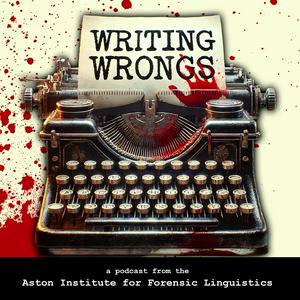
Writing Wrongs, from the Aston Institute for Forensic Linguistics, explores historic and contemporary forensic linguistic cases.
Hosts Professor Tim Grant and Dr Nicci MacLeod, who've provided expert evidence in hundreds of cases, examine a specific case and its linguistic analysis each episode.
Some episodes feature guest forensic linguists sharing their experiences as expert witnesses. The series highlights different case types, showcasing the strengths and limitations of forensic linguistics in criminal and civil investigations.
Sitio web del podcastEscucha Writing Wrongs, TE CUENTO UN CRIMEN y muchos más podcasts de todo el mundo con la aplicación de radio.net
Descarga la app gratuita: radio.net
- Añadir radios y podcasts a favoritos
- Transmisión por Wi-Fi y Bluetooth
- Carplay & Android Auto compatible
- Muchas otras funciones de la app
 México

