

Escucha gratis este podcast en la aplicación: Descarga gratuita en la App Store
radio.net
Sleep timer
Favoritos
Eric Hörst's Training For Climbing Podcast
Eric J. Hörst
Último episodio
118 episodios
#133 - CRUSHERS: Kevin Dahlstrom on His Life Reboot, Injury, TRT, and Climbing Hard Over Age 40
08/09/2026 | 1 h 6 minWhat if some of your best climbing is still ahead of you—even after age 40? My latest T4C Podcast guest, Kevin Dahlstrom, didn't climb his first 5.13 until age 50. Five years later, he was having the strongest season of his life and chasing 5.13c—until a freak accident in Mexico caused a catastrophic triceps tendon tear and major surgery.
In this episode, Kevin and I dig into his comeback, training and recovery after 40, and why aging climbers need to become increasingly intentional about sleep, nutrition, mobility, recovery, and targeted training. We also explore health monitoring, testosterone, peptides, and Kevin's audacious long-term goal of climbing 5.14.
But this conversation is about much more than climbing grades. Kevin left a highly successful corporate career in his late 40s to reorganize his life around something even more valuable: time. His idea of becoming a "time billionaire" sparks a fascinating discussion about aging, ambition, priorities, and how to stay strong, adventurous, and fully engaged with life for decades to come.
Rundown
00:00 – Cold Open: Kevin's Midlife Reboot Kevin leaves a high-paying corporate career in Texas, moves his family to Colorado, climbs harder than ever—and then faces a catastrophic arm injury.
01:10 – Episode Introduction Introducing Kevin Dahlstrom, the CRUSHERS series, and the episode's central themes: climbing after 50, health, longevity, injury recovery, and becoming a "time billionaire."
03:15 – Interview Begins: Kevin's Best Climbing Season at Age 55 Kevin describes reaching the best climbing fitness of his life, sending multiple 5.13bs, and falling from the final move of a 5.13c.
06:12 – The Freak Accident in Mexico A foothold breaks on a warm-up route, sending Kevin into a tufa and completely tearing his distal triceps tendon from the elbow.
10:05 – Surgery, Rehabilitation and Returning to Climbing Kevin explains the cadaver tendon graft used to reconstruct his arm and his carefully graded return from 5.6 toward harder climbing.
12:03 – Climbing His First 5.13 at Age 50 After two decades as a trad climber, Kevin sets an audacious goal of climbing ten 5.13s in one year—and succeeds.
14:40 – Discovering Climbing and Becoming a Traveling Weekend Warrior Kevin recounts finding climbing in a Dallas grain-silo gym, leading his first trad route the following weekend, and eventually taking around 20 climbing trips per year.
16:36 – Walking Away From Corporate Success Despite reaching the C-suite of a multibillion-dollar company, Kevin realizes that professional and financial success have not made him happier.
21:00 – Running Toward an Irresistible Life Kevin explains why major life changes are often driven not by what we're escaping, but by something meaningful that we feel compelled to pursue.
23:15 – The "Time Billionaire" Concept A billion seconds equals roughly 30 years. Kevin explains why time—not money—is ultimately our most valuable and irreplaceable asset.
25:48 – Kevin's Training Approach After 50 Climbing outside three to five days per week, trying extremely hard, supplementing with hangboarding, and increasingly prioritizing mobility.
28:50 – Balancing Hard Projects With Pure Enjoyment Why projecting can be deeply satisfying—but not every climbing day needs to become a redpoint battle.
31:05 – Identifying Kevin's Limiting Constraint At 6'3" and approximately 200 pounds, Kevin discusses strength-to-weight ratio, bouldering power, and why V7–V8 movement is becoming his performance bottleneck.
32:31 – Targeted Training and System-Wall Climbing Eric recommends carefully progressed Kilter Board or Tension Board training to build maximum strength, power, and high-end bouldering ability.
35:00 – Why Masters Climbers Should Pick Their Battles Older climbers may benefit from selecting inspiring routes that fit their strengths rather than trying to master every possible climbing style.
41:17 – Can You Still Improve in Your 40s, 50s and 60s? Kevin and Eric challenge the belief that climbers are automatically past their prime at 40 and discuss why older athletes must "turn the screws tighter" on the details.
44:30 – Tracking Health and Performance Biomarkers Why longitudinal blood testing can provide a valuable dashboard for understanding changes in recovery, energy, hormones and overall health.
45:33 – Kevin's Experience With Testosterone Replacement Therapy Kevin discusses declining testosterone, related symptoms, medically supervised treatment, recovery benefits, and why TRT may be a wash for climbing performance.
52:23 – Optimize the Fundamentals First Sleep, nutrition, resistance training, body composition and lifestyle should be addressed before considering hormone therapy or more advanced interventions.
53:40 – Peptides and the Longevity "Wild West" Kevin and Eric discuss the potential—and considerable risks—of peptides, including Kevin's medically supervised postoperative use of BPC-157.
56:08 – Kevin's Goal of Climbing 5.14 Kevin considers possible projects, including Cheating Reality in the Flatirons, and explains why the route must fit both his strengths and his deeper inspiration.
58:48 – Writing, Personal Development and @Camp4 Kevin discusses his daily writing practice, his X/Twitter presence, and sharing lessons about climbing, work, happiness and building a meaningful life.
61:30 – Eric's Key Takeaways for Masters Climbers A concise recap covering continued improvement, smarter training, recovery, mobility, health monitoring, injury resilience and the true value of time.
Key Takeaways
1. Stop assuming that age automatically means decline.
Your ultimate physiological ceiling will eventually fall, but many climbers have never approached that ceiling. Better training, tactics, movement, nutrition, recovery, and consistency can outweigh some age-related losses for many years.
2. You can still set personal bests in your 40s, 50s, and 60s.
Kevin didn't climb 5.13 until age 50. Five years later, he was having his best climbing season ever.
3. The older you get, the more the details matter.
Sleep, nutrition, mobility, recovery, training quality, and smart decision-making become increasingly important. (Read more on this topic >>)
4. Train the constraint—not simply your favorite strength.
Kevin's endurance, tactics, and resting ability are already strong. Higher-end bouldering power is increasingly the bottleneck. Breaking a plateau requires identifying and targeting that constraint.
5. Don't confuse more training with better training.
Masters athletes have less margin for unnecessary fatigue. High-quality work followed by sufficient recovery often beats simply accumulating volume.
6. Preserve mobility and strength before you desperately need them.
Kevin wishes he had prioritized mobility earlier. Maintaining usable range of motion and joint function is an investment in your future climbing.
7. Pick your battles.
You don't need to prove that you can climb every style. Choose routes and destinations that inspire you and give you a realistic opportunity to express your strengths.
8. Keep some climbing purely fun.
Projects provide purpose and challenge, but not every day needs to be a redpoint battle.
9. Injuries are chapters—not necessarily endings.
Kevin's catastrophic triceps tear removed climbing from his life temporarily, but his goal isn't simply returning to climbing. It's returning stronger and continuing for decades.
10. Track your health—not just your climbing grades.
As you get older, your health and athletic performance become increasingly intertwined. Appropriate medical evaluation and longitudinal health data may provide useful context for changes in recovery, energy, and performance.
11. Be cautious with longevity "hacks."
New therapies may eventually prove valuable, but promising anecdotes aren't the same thing as high-quality human evidence.
12. Remember what you're ultimately optimizing for.
Money matters. Achievement matters. Climbing grades matter.
But they aren't the only scorecard -- Kevin's central message may be the most important one in this entire conversation: Time is the truly scarce asset.
The goal is to intentionally turn that time into experiences, relationships, achievement, adventure—and ultimately, meaning.
👉 Follow Kevin on X/Twitter: @Camp4, where he writes about climbing, health, personal development, work, money, happiness, and building a more intentional life. His newsletter is also available through the link on his X profile.
Please leave a 5-star review on Apple Podcasts or Spotify, and share this episode with a climbing partner or friend!
Podcast Sponsors
Thank you to La Sportiva, PhysiVantage Nutrition, DMM Climbing, Blue Water Ropes!
Save 10% off a new BlueWater Rope with checkout code: ERIC_CLINIC
Save on La Sportiva shoes here >>
Save 15% off full-priced PhysiVantage Nutrition with code: PODCAST15 (North America only)
European climbers, please get your PhysiVantage from the EPIC-TV Shop or Oliunid.com.
Mexican climbers visit PhysiVantage.mx
Connect with Eric Hörst
📬 Training for Climbing Newsletter Get monthly training insights delivered to your inbox. Visit TrainingForClimbing.com to subscribe.
📱 Follow Eric Instagram: @eric_horst | @training4climbing YouTube: Training For Climbing Twitter: @Train4Climbing Facebook: Training For Climbing
Music by Misty Murphy
Copyright 2026 Eric Hörst | Horst Training, LLC.#132 - Climb Harder Through Self-Mastery: 9 Lessons for Better Training & Performance
18/08/2026 | 37 minWhat if the biggest thing holding back your climbing isn't finger strength, power endurance, body weight, age—or finding the perfect training program? What if the real limiter is much simpler: you're not consistently doing the things you already know you should be doing?
In this new episode of the Training for Climbing Podcast, I dig into 9 powerful principles for behavior modification and self-mastery—and how they can help you train more consistently, improve your nutrition, manage your time, recover better, and become a stronger, more disciplined climber. We'll explore everything from questioning the stories you tell yourself and building an athlete identity, to embracing invisible progress, keeping promises to yourself, and making decisions based on principles rather than emotions.
Because long-term success isn't about being perfectly motivated or discovering some secret training hack. It's about controlling the controllables, showing up, learning from failure, and repeatedly doing the small things that move you toward the athlete you want to become. If you want to climb harder—and become better at the game of life along the way—give this episode a listen. 🎧💪🧗
The 9 Lessons for Self-Mastery:
(2:30) 1. Question the story you keep telling yourself.
(5:46) 2. You don't have to believe everything you think.
(9:06) 3. Stop chasing goals—build the identity that achieves them.
(12:30) 4. Small behaviors compound.
(19:25) 5. Learn to love invisible progress.
(22:28) 6. Use your past as data, not identity.
(24:45) 7. Discipline means keeping promises to yourself.
(27:07) 8. Let principles make decisions before emotions arrive.
(29:19) 9. Control the controllables.
(31:20) - Three important questions for you to answer today!
The big takeaway: long-term climbing success isn't built on perfect motivation or heroic workouts. It comes from repeatedly making good decisions, learning from failure, protecting your health, showing up, and gradually becoming the athlete capable of achieving your goals. Let's go!
Learn more on this topic. Listen to T4C podcast #124 - Possibility Thinking: 15 Concepts That Changed My Life >>
Please leave a 5-star review on Apple Podcasts or Spotify, and share this episode with a climbing partner or friend!
Podcast Sponsors
Thank you to La Sportiva, PhysiVantage Nutrition, DMM Climbing, Blue Water Ropes!
Save 10% off a new BlueWater Rope with checkout code: ERIC_CLINIC
Save on La Sportiva shoes here >>
Save 15% off full-priced PhysiVantage Nutrition with code: PODCAST15 (North America only)
European climbers, please get your PhysiVantage from the EPIC-TV Shop or Oliunid.com.
Mexican climbers visit PhysiVantage.mx
Connect with Eric Hörst
📬 Training for Climbing Newsletter Get monthly training insights delivered to your inbox. Visit TrainingForClimbing.com to subscribe.
📱 Follow Eric Instagram: @eric_horst | @training4climbing YouTube: Training For Climbing Twitter: @Train4Climbing Facebook: Training For Climbing
Music by Misty Murphy
Copyright 2026 Eric Hörst | Horst Training, LLC.#131: Endurance Masterclass: Training and Tactics to Beat the Pump!
21/07/2026 | 1 h 22 minWant to climb longer, recover faster, and finally stop getting pumped off your project? Then this episode is for you.
In this special coaching session with Ryan Devlin, I deliver a deep-dive masterclass on rock climbing endurance training, sport climbing performance, and the science of building lasting endurance.
We explore why improving endurance isn't just about surviving pumpy workouts—it's about becoming a more efficient climber by eliminating hidden energy leaks caused by overgripping, poor pacing, inefficient movement, fear, hesitation, and mental tension. You'll learn how better technique, movement economy, breathing, and confidence can dramatically improve your endurance before you ever change your fitness.
Next, we dive into the physiology of climbing performance, breaking down the differences between aerobic endurance, anaerobic power endurance, and maximum strength—and why all three must be trained if you want to reach your climbing potential. I explain how to structure your training using route climbing, treadwall intervals, spray wall workouts, bouldering circuits, and submaximal volume sessions to build endurance the smart way instead of simply climbing until your forearms explode.
Whether you're training for your first 5.12, projecting steep sport routes, preparing for long days at the crag, or simply looking for the most effective climbing training methods backed by exercise science and decades of coaching experience, this episode is packed with practical strategies you can apply immediately. If you're serious about becoming a stronger, more durable, and more efficient climber, this is an episode you'll want to save, revisit, and share with your climbing partners.
If you love the T4C podcast, please leave a 5-star review on Apple Podcasts and share this episode with a friend or climbing partner!
Podcast Sponsors
Thank you to La Sportiva, PhysiVantage Nutrition, DMM Climbing, Blue Water Ropes!
Save 10% off a new BlueWater Rope with checkout code: ERIC_CLINIC
Save on La Sportiva shoes here >>
Save 15% off full-priced PhysiVantage Nutrition with code: PODCAST15 (North America only)
European climbers, please get your PhysiVantage from the EPIC-TV Shop or Oliunid.com.
Mexican climbers visit PhysiVantage.mx
Connect with Eric Hörst
📬 Training for Climbing Newsletter Get monthly training insights delivered to your inbox. Visit TrainingForClimbing.com to subscribe.
📱 Follow Eric Instagram: @eric_horst | @training4climbing YouTube: Training For Climbing Twitter: @Train4Climbing Facebook: Training For Climbing
Cover photo: by Caleb Timmerman
Music by Misty Murphy
Copyright 2026 Eric Hörst | Horst Training, LLC.#130 - PRO TIPS: Cameron Horst's Training Secrets Behind a 5.15a Send
09/06/2026 | 57 minCameron Hörst recently completed the hardest route of his climbing career: Big Bone (5.15a/9a+), a king line out Utah's massive Fynn Cave.
What makes his first ascent especially compelling isn't just the grade—it's the journey. Big Bone was a project that demanded years of training, 60+ working goes and redpoint attempts, countless setbacks, and a level of patience few climbers ever develop.
In this episode of the Training for Climbing Podcast, Cameron unpacks the entire process. We dive into the physical, mental, and tactical challenges of working a multi-year project, the breakthroughs that finally moved the needle, and the lessons any climber can apply to their own long-term goals—whether you're projecting 5.10 or 5.15.
One of the most fascinating takeaways is that the breakthrough wasn't a sudden gain in finger strength or power. Instead, it came from years of accumulated training adaptations, comprehensive energy system development, improved recovery, refined tactics, and learning when not to climb. Cameron shares how he finally broke through a plateau that had stalled his progress for multiple seasons.
RUNDOWN
2:00 – What Does It Feel Like to Send a Multi-Year Project?
5:00 – Inside Utah's Incredible Fin Cave
7:00 – Anatomy of the "Big Bone" Project
9:50 – Why the Route is So Difficult
12:00 – Cameron's Three-Year Journey on the Route
13:50 – Breaking Through a Plateau
16:40 – Training Lessons from Big Bone
18:00 – Recovery: The Secret Weapon
21:00 – Sending on the Second Try
24:10 - Energy System Training and the benefits of becoming more fat adapted
26:00 – Mental Growth and Performance Psychology
28:30 - Discovery of Fin Cave
31:30 – The Evolution of "Bone Tomahawk" and "Big Bone"
32:00 – Friendship and Mentorship with Joe Kinder
34:20 – Balancing University, Life, and Elite Climbing
40:00 – The Importance of Partners and Community
44:00 - Debating 5.15a versus 5.15b -- how to grade a hard FA?
47:30 - Ultimately, the grade isn't important -- the journey is what counts!
48:10 – Coaching, Exercise Science, and Helping Others
Follow and contact Cameron on Instagram @cam_horst
Visit Cam's website at: www.CameronHorst.com
49:28 – What's Next?
51:05 – Eric's summarizes 8 Key Tips and Takeaways from this interview.
54:30 - Sponsor Discount:
Save 15% off full-priced PhysiVantage Nutrition with code: PODCAST15 (North America only)
56:00 -⭐ Enjoy the podcast?
Leave a 5-star review on Apple Podcasts and share this episode with a climbing partner!
56:40 - Hörst Out!
Podcast Sponsors
Thank you to La Sportiva, PhysiVantage Nutrition, DMM Climbing, Blue Water Ropes!
Save 10% off a new BlueWater Rope with checkout code: ERIC_CLINIC
Save on La Sportiva shoes here >>
Save 15% off full-priced PhysiVantage Nutrition with code: PODCAST15 (North America only)
European climbers, please get your PhysiVantage from the EPIC-TV Shop or Oliunid.com.
Mexican climbers visit PhysiVantage.mx
Connect with Eric Hörst
📬 Training for Climbing Newsletter Get monthly training insights delivered to your inbox. Visit TrainingForClimbing.com to subscribe.
📱 Follow Eric Instagram: @eric_horst | @training4climbing YouTube: Training For Climbing Twitter: @Train4Climbing Facebook: Training For Climbing
Music by Misty Murphy
Copyright 2026 Eric Hörst | Horst Training, LLC.#129 - WEEKEND CRUSHER: From Florida to 5.13d - The Jessica Jenkins Story
17/05/2026 | 34 minIn this inspiring new "Weekend Crushers" feature, I sit down with Florida-based climber Jessica Jenkins to unpack her incredible journey from a teenager climbing plastic in Orlando to recently sending her hardest route ever: the iconic Red River Gorge testpiece Swingline (5.13d). Her story is far more than a tale of grades and performance—it's a masterclass in resilience, adaptability, patience, and building a life that supports your passion even when circumstances aren't ideal.
Whether you live far from outdoor climbing, struggle to balance work and family with training, or simply need a reminder that long-term consistency still wins, I think you'll find Jessica's story deeply motivating. Her journey proves that you don't need perfect circumstances to pursue extraordinary goals—you just need commitment, structure, and the willingness to keep showing up.
Key Inspirational Takeaways for Climbers Living Far from Rock
1. Your location does not define your potential.
Jessica proves that you do not need to live in Boulder, Salt Lake, or Chattanooga to become a high-level climber. Smart training, consistency, and strategic travel can close much of the gap.
2. Training with intention matters more than perfect access.
Because she can't climb outdoors weekly, Jessica trains with incredible specificity—adjusting board angles, targeting pocket strength for Wyoming trips, and using power-endurance circuits to prepare for the Red River Gorge.
3. Passion fuels discipline.
Long drives, limited outdoor mileage, inconsistent weather, and balancing work obligations would discourage many climbers. But Jessica's love for climbing continues to drive her effort year after year.
4. Progress is rarely linear.
Even highly prepared climbers experience setbacks, regressions, injuries, and emotional struggles. Near-sends and failures are often part of the process—not signs that the goal is impossible.
5. Build a life that supports your passion.
Jessica intentionally shaped her career and lifestyle around climbing freedom. Rather than waiting for ideal circumstances, she created systems that allowed climbing to remain central in her life.
6. Long-term consistency beats short-term intensity.
Jessica's breakthrough wasn't the result of one magical training cycle. It was built over 16 years of climbing, coaching, learning, traveling, and steadily improving.
7. Community matters.
The interview highlights how supportive partners, climbing friends, coaches, and mentors can make a huge difference—especially for climbers who live far from outdoor destinations.
⭐ Enjoy the podcast? Leave a 5-star review on Apple Podcasts and share this episode with a climbing partner!
Podcast Sponsors
Thank you to La Sportiva, PhysiVantage Nutrition, DMM Climbing, Blue Water Ropes!
Save 10% off a new BlueWater Rope with checkout code: ERIC_CLINIC
Save on La Sportiva shoes here >>
Save 15% off full-priced PhysiVantage Nutrition with code: PODCAST15 (North America only)
European climbers, please get your PhysiVantage from the EPIC-TV Shop or Oliunid.com.
Mexican climbers visit PhysiVantage.mx
Connect with Eric Hörst
📬 Training for Climbing Newsletter Get monthly training insights delivered to your inbox. Visit TrainingForClimbing.com to subscribe.
📱 Follow Eric Instagram: @eric_horst | @training4climbing YouTube: Training For Climbing Twitter: @Train4Climbing Facebook: Training For Climbing
Music by Misty Murphy
Copyright 2026 Eric Hörst | Horst Training, LLC.
Más podcasts de Aventuras en la naturaleza
 Climbing GoldAventuras en la naturaleza, Deportes
 Downtime - The Mountain Bike PodcastAventuras en la naturaleza, Deportes, Fitness, Ocio, Pasatiempos, Salud y forma física
 Big Game Hunting Podcast - Hunting Africa, North America, & More!Aventuras en la naturaleza, Deportes, Ocio, Pasatiempos
 Bear GreaseAventuras en la naturaleza, Deportes
Podcasts a la moda de Aventuras en la naturaleza

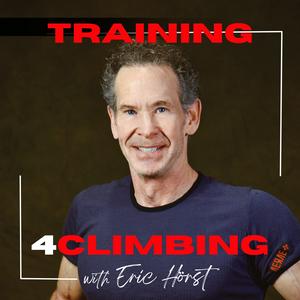
Acerca de Eric Hörst's Training For Climbing Podcast
Training and performance podcasts by Eric Hörst, the internationally renowned author, researcher, climbing coach, and climber of 40 years. Monthly podcasts detail the latest training techniques to improve strength, power, endurance, as well as mental and technical skills. With his unique combination of veteran experience and knowledge of the cutting-edge research, Eric presents practical, effective guidelines to climb harder, reduce injury risk, and maximize the experience of moving over stone.
Eric is one of the world's most knowledge climbing coaches and his eight books (and many foreign translations) have sold more than 300,000 copies worldwide. His latest book release is the 3rd edition of Training For Climbing. Learn more at: http://www.trainingforclimbing.com
Sitio web del podcastEscucha Eric Hörst's Training For Climbing Podcast, Climbing Gold y muchos más podcasts de todo el mundo con la aplicación de radio.net
Descarga la app gratuita: radio.net
- Añadir radios y podcasts a favoritos
- Transmisión por Wi-Fi y Bluetooth
- Carplay & Android Auto compatible
- Muchas otras funciones de la app
Descarga la app gratuita: radio.net
- Añadir radios y podcasts a favoritos
- Transmisión por Wi-Fi y Bluetooth
- Carplay & Android Auto compatible
- Muchas otras funciones de la app

Eric Hörst's Training For Climbing Podcast
Escanea el código,
Descarga la app,
Escucha.
Descarga la app,
Escucha.
 México