

Escucha gratis este podcast en la aplicación: Descarga gratuita en la App Store
radio.net
Sleep timer
Favoritos
24 episodios
23: The Colonial, the Post-Colonial, the Global
09/12/2022 | 52 minHow does all this tie together? Class 23 brings the effects of the past century of imperialism into sharp focus.
Timothy Snyder is the Richard C. Levin Professor of History at Yale University and a permanent fellow at the Institute for Human Sciences in Vienna. He speaks five and reads ten European languages.
Ukraine must have existed as a society and polity on 23 February 2022, else Ukrainians would not have collectively resisted Russian invasion the next day. What does it mean for a nation to exist? Is this a matter of structures, actions, or both? Why has the existence of Ukraine occasioned such controversy? In what ways are Polish, Russian, and Jewish self-understanding dependent upon experiences in Ukraine? Just how and when did a modern Ukrainian nation emerge? For that matter, how does any modern nation emerge? Why some and not others? Can nations be chosen, and can choices be decisive? If so, whose, and how? Ukraine was the country most touched by Soviet and Nazi terror: what can we learn about those systems, then, from Ukraine? Is the post-colonial, multilingual Ukrainian nation a holdover from the past, or does it hold some promise for the future?
Course reading list
Video version of this course available on YouTube.22: Ukrainian Ideas in the 21st Century
06/12/2022 | 51 minClass 22 brings us closer to the modern day and looks at the role of culture.
Timothy Snyder is the Richard C. Levin Professor of History at Yale University and a permanent fellow at the Institute for Human Sciences in Vienna. He speaks five and reads ten European languages.
Ukraine must have existed as a society and polity on 23 February 2022, else Ukrainians would not have collectively resisted Russian invasion the next day. What does it mean for a nation to exist? Is this a matter of structures, actions, or both? Why has the existence of Ukraine occasioned such controversy? In what ways are Polish, Russian, and Jewish self-understanding dependent upon experiences in Ukraine? Just how and when did a modern Ukrainian nation emerge? For that matter, how does any modern nation emerge? Why some and not others? Can nations be chosen, and can choices be decisive? If so, whose, and how? Ukraine was the country most touched by Soviet and Nazi terror: what can we learn about those systems, then, from Ukraine? Is the post-colonial, multilingual Ukrainian nation a holdover from the past, or does it hold some promise for the future?
Course reading list
Video version of this course available on YouTube.21: Comparative Russian Imperialism
01/12/2022 | 48 minClass 21 features guest lecturer, Professor Arne Westad, comparing Russian imperialism with other empires in recent centuries.
Timothy Snyder is the Richard C. Levin Professor of History at Yale University and a permanent fellow at the Institute for Human Sciences in Vienna. He speaks five and reads ten European languages.
Ukraine must have existed as a society and polity on 23 February 2022, else Ukrainians would not have collectively resisted Russian invasion the next day. What does it mean for a nation to exist? Is this a matter of structures, actions, or both? Why has the existence of Ukraine occasioned such controversy? In what ways are Polish, Russian, and Jewish self-understanding dependent upon experiences in Ukraine? Just how and when did a modern Ukrainian nation emerge? For that matter, how does any modern nation emerge? Why some and not others? Can nations be chosen, and can choices be decisive? If so, whose, and how? Ukraine was the country most touched by Soviet and Nazi terror: what can we learn about those systems, then, from Ukraine? Is the post-colonial, multilingual Ukrainian nation a holdover from the past, or does it hold some promise for the future?
Course reading list
Video version of this course available on YouTube.20: Maidan and Self-Understanding with guest lecturer Marci Shore
28/11/2022 | 53 minWhat can be that breaking point in a person’s life? Class 20 brings us to Maidan and the Self-Understanding that resulted. Guest lecturer is Marci Shore, Associate Professor of History at Yale University.
Marci Shore, Ukrainian Night: An Intimate History of Revolution, New Haven: Yale University Press, 2018.
Timothy Snyder is the Richard C. Levin Professor of History at Yale University and a permanent fellow at the Institute for Human Sciences in Vienna. He speaks five and reads ten European languages.
Ukraine must have existed as a society and polity on 23 February 2022, else Ukrainians would not have collectively resisted Russian invasion the next day. What does it mean for a nation to exist? Is this a matter of structures, actions, or both? Why has the existence of Ukraine occasioned such controversy? In what ways are Polish, Russian, and Jewish self-understanding dependent upon experiences in Ukraine? Just how and when did a modern Ukrainian nation emerge? For that matter, how does any modern nation emerge? Why some and not others? Can nations be chosen, and can choices be decisive? If so, whose, and how? Ukraine was the country most touched by Soviet and Nazi terror: what can we learn about those systems, then, from Ukraine? Is the post-colonial, multilingual Ukrainian nation a holdover from the past, or does it hold some promise for the future?
Course reading list
Video version of this course available on YouTube.19: Oligarchies in Russia and Ukraine
28/11/2022 | 48 minClass 19 brings additional reminders of the impact Poland had on the formation of the Ukrainian state.
Timothy Snyder is the Richard C. Levin Professor of History at Yale University and a permanent fellow at the Institute for Human Sciences in Vienna. He speaks five and reads ten European languages.
Ukraine must have existed as a society and polity on 23 February 2022, else Ukrainians would not have collectively resisted Russian invasion the next day. What does it mean for a nation to exist? Is this a matter of structures, actions, or both? Why has the existence of Ukraine occasioned such controversy? In what ways are Polish, Russian, and Jewish self-understanding dependent upon experiences in Ukraine? Just how and when did a modern Ukrainian nation emerge? For that matter, how does any modern nation emerge? Why some and not others? Can nations be chosen, and can choices be decisive? If so, whose, and how? Ukraine was the country most touched by Soviet and Nazi terror: what can we learn about those systems, then, from Ukraine? Is the post-colonial, multilingual Ukrainian nation a holdover from the past, or does it hold some promise for the future?
Course reading list
Video version of this course available on YouTube.
Más podcasts de Cursos
 Real English Conversations Podcast | English Fluency For Newcomers And International ProfessionalsAprendizaje de idiomas, Cursos, Educación
 Aprende inglés con Trainlang | Nivel A1 Beginner (Temporada 2)Cursos, Educación
 La psicología del éxito!Cursos, Educación
 Aprende ingles hoy: Entrenate para aprender rapido y facilCursos, Educación
 Mejora tu Comunicación AsertivaCursos, Educación
 La Fonda Filosófica (audio)
 Colegio de Contadores Públicos de Guadalajara Jalisco A.C.Cursos, Educación
 Oratoria EficazCursos, Educación
 PSICOLOGIA CORPORALCursos, Educación
Podcasts a la moda de Cursos


Acerca de The Making of Modern Ukraine
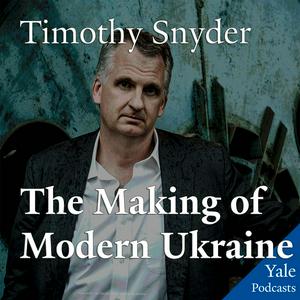
Ukraine must have existed as a society and polity on 23 February 2022, else Ukrainians would not have collectively resisted Russian invasion the next day. What does it mean for a nation to exist? Timothy Snyder explores these and other questions in a very timely course.
This course was recorded live in a classroom at Yale University in the autumn of 2022.
Sitio web del podcastEscucha The Making of Modern Ukraine, Real English Conversations Podcast | English Fluency For Newcomers And International Professionals y muchos más podcasts de todo el mundo con la aplicación de radio.net
Descarga la app gratuita: radio.net
- Añadir radios y podcasts a favoritos
- Transmisión por Wi-Fi y Bluetooth
- Carplay & Android Auto compatible
- Muchas otras funciones de la app
Descarga la app gratuita: radio.net
- Añadir radios y podcasts a favoritos
- Transmisión por Wi-Fi y Bluetooth
- Carplay & Android Auto compatible
- Muchas otras funciones de la app

The Making of Modern Ukraine
Escanea el código,
Descarga la app,
Escucha.
Descarga la app,
Escucha.
The Making of Modern Ukraine: Podcasts del grupo
 México