
Escucha gratis este podcast en la aplicación: Descarga gratuita en la App Store
radio.net
Sleep timer
Favoritos
559 episodios

AI Agents Need a Babysitter
23/10/2026 | 45 minAI can write your code, choose its own tools, and book your next trip. But who checks that it actually did the job?
In this episode of Debug Mode, we explore what it takes to give AI agents more responsibility—and how to keep track of what they’re doing. We discuss intent-based tool selection, MCP and WebMCP, and why a convincing demo doesn’t always translate into reliable automation.
We also get into the personal AI assistant everyone seems to be building: one that manages travel, handles household tasks, and hopefully remembers to order coffee before you run out.
Then it’s back to code: QA agents, automated verification, tests that capture business intent, and the growing challenge of reviewing AI-generated contributions.
Timestamps:[00:00] Who gave AI the keys?[00:43] A tattoo years in the making[02:40] Tell the agent what you want—not which tool[06:19] MCP enters the agent harness[07:23] Great demo. What do the benchmarks say?[09:55] AI builders rediscover machine learning[11:50] Can WebMCP make agents more reliable?[16:04] Unlocking tools like a video game skill tree[18:19] Let an agent try to break your website[19:50] Are humans still in the driver’s seat?[20:38] Build for the outcome, not the API[24:32] Why can’t AI keep my coffee stocked?[27:38] A house manager for the rest of us[29:23] A travel agent that actually handles things[30:49] When your AI chat becomes your workspace[34:12] Does superintelligence need a rebrand?[35:06] Who checks the code AI writes?[36:31] Test why the code exists—not just if it works[41:08] Give your coding agent a QA partner[43:18] The checks failed. Why submit it anyway?[44:33] Open source meets the AI code floodToken Maxxing Is Over and Here Is What Comes Next
22/10/2026 | 35 minWhat happens when you give 200 engineers who have barely touched AI a coding assistant and a six-month deadline to rebuild their platform? Pepijn Senders, a principal engineer who previously led AI enablement at HelloFresh, has done exactly that, and he chose Sonnet over Opus on purpose.
His reasoning is what he calls "Sonnet maxxing." A model that reasons less and stops sooner keeps developers involved, and that matters a lot when the codebase is banking software full of hard business rules. The result was 800,000 lines of code, about 60% of them written by Sonnet, shipped by a team that never stopped thinking for itself. Pep also explains how to justify the spend once the token-maxxing era ends and the CFO starts asking questions. He covers a scatter chart that plots token spend against output, the uncomfortable question of whether a 1% better home screen was worth $20K in tokens, why he measures gains in headcount rather than 2x or 3x multipliers, and where he fell short when trying to prove ROI at HelloFresh.
We also get into a codebase test you can run yourself, why AI recommendations quietly narrow your choices, and multiplayer refinement sessions where the whole team works through the agent's questions together. Pep shares an experiment where designers and engineers got the same one-shot prompt, and it showed how words like "scalable" and "maintainable" steer a model. We finish with how his team built a meta harness on top of Claude Code, after finding that 85% of their code followed the same path: refinement, specification, implementation, verification.
Demetrios Brinkmann: https://www.linkedin.com/in/dpbrinkm
Pepijn Senders: https://www.linkedin.com/in/pepijn-senders
Timestamps:
[0:00] Can you still read your codebase
[1:15] Meet Pep from HelloFresh
[2:35] What is Sonnet Maxing
[3:41] Rebuilding a platform in six months
[5:02] Why Sonnet made adoption easier than Copilot
[6:37] Proving the ROI of AI coding
[8:50] Fighting for AI ROI at HelloFresh
[11:02] Token spend vs output
[13:24] Tinder pickup lines on the company dime
[14:13] Measuring ROI in headcount saved
[18:26] Keeping humans in control of AI code
[22:26] When Opus and Fable stop speaking English
[24:19] Multiplayer refinement sessions with AI
[28:16] Magic words that steer the model
[32:32] Inside the company Meta harnessesThe World Wild Web & Bots With Buying Power
20/10/2026 | 49 minAn AI slips out of its sandbox. A chatbot won’t explain your cat’s stripes. And your next shopping spree might not involve you clicking anything.
This episode asks whether “dangerously powerful” AI is a security concern, a marketing pitch, or a little of both. Then we put agents to work: booking trips, tackling German paperwork, drawing diagrams, and navigating the chaos of online shopping. Plus: what happens to checkout, advertising, and customer data when your best customer is a bot?
Chapters:[00:00] Is AI Danger the Ultimate Sales Pitch?[00:43] Powerful Models, Payments, and Big Questions[01:10] Too Dangerous to Release, Too Good to Ignore?[03:19] Why Take the Test When You Can Steal the Answers?[08:36] A Security Failure or a Marketing Win?[11:02] Powerful AI, Forbidden Cat Questions[16:00] AI Only Needs to Find One Unlocked Door[20:52] Welcome to the World Wild Web[22:47] What Happens When You Give AI a Wallet?[26:00] Could ChatGPT Become the Next Amazon?[29:50] Mum Wants a Holiday. Can AI Handle It?[33:38] Can AI Beat German Bureaucracy?[36:28] Claude, Draw My Diagram[39:39] Why Is Connecting Your Email Still So Hard?[44:24] Stop Giving Me Options. Just Buy the Sofa.[46:40] When Bots Shop, Who Owns the Customer?Agents Acting Safely on Our Behalf
15/10/2026 | 23 minWhat happens to the web when the ones browsing it are no longer people? Sarah Drasner, Area Tech Lead at Google, sits down with us ahead of her Agentic Web keynote at AGNTCon + MCPCon North America. She works through that question from both directions: rebuild the web so agents can use it properly, or build agents smart enough to handle the web as it already exists.
We get into the split between computer-use and browser-use agents on one side and API and MCP agents on the other. We also watch a real example of the idea in action: an agent pulling speaker photos from Flickr, hunting down company logos, and loading everything into Canva so the human only touches the creative part. From there, Sarah shares the unlikely origin story of WebMCP (and who's to blame for it). We then pressure-test a bold idea: a WebMCP gateway that could cover the huge share of websites that will never ship support on their own.
Along the way, we cover the instinct that separates senior engineers, the ability to sense which business problems are actually worth solving. We also talk about how thought experiments cut through a pile of competing priorities, the hacky WebMCP workarounds already showing up in the wild, and why the best agent experiences are the ones that delight customers in ways they never saw coming.
Demetrios Brinkmann: https://www.linkedin.com/in/dpbrinkm
Sarah Drasner: https://www.linkedin.com/in/sarahdrasner
Timestamps:
[0:00] Cold open
[0:52] The AGNTCon keynote
[1:23] Change the web or fix agents
[3:35] Browser agents vs MCP agents
[5:48] An agent that builds thumbnails
[7:03] Keeping the creative work human
[9:12] Agent allowances and engineering instinct
[13:34] Thought experiments and priorities
[15:23] The WebMCP origin story
[17:08] A WebMCP gateway for the web
[18:53] It works, but it is not ideal
[19:44] Hacky WebMCP in the wildBridging the Gap Between AI Builders and Domain Experts
12/10/2026 | 22 minEveryone is racing to build one agent that can do everything. Justin Schroeder, co-founder of Standard Agents, thinks the future looks more like thousands of tiny ones. Ahead of his talk on domain-specific agents at AGNTCon + MCPCon North America, he explains why tightly scoped agents might be the smarter bet, even if it feels like a step back toward the single-purpose machine learning models of a few years ago.
We dig into standards as metadata you pin to an agent, so that it shows up with everything it needs in its harness. Then we test the idea against the obvious objection: if a big model can already handle the task, why scope down at all? The answer covers forcing functions, a microservices mindset for agent design, and small agents that quietly check issues or unread messages every five minutes. It also covers the surprise $1K bill waiting for anyone who leaves their agents running.
Then it turns into a proper debate. Our host is 99% sure the agent marketplace will never happen, and Justin arrives with a counter that might change his mind (hint: think about where your skills come from). Along the way, we cover agents as tools versus a big-brain router and how anyone keeps track of a thousand agents. We also talk about why the people who know what agents can do and the people who know what they need still have to meet in the middle.
Demetrios Brinkmann: https://www.linkedin.com/in/dpbrinkm
Justin Shroeder: https://www.linkedin.com/in/jpschroeder
Timestamps:
[0:00] Cold open
[1:03] The future is domain-specific agents
[1:51] God models vs specialist agents
[2:20] The perfect Gmail agent
[3:14] Why standards are missing
[3:29] Train the prompt, not the model
[4:30] The harness beats the model
[6:07] Standards and runtimes for agents
[8:17] Why scope down at all
[10:07] Why model routing won't win
[10:29] The surprise $1K bill
[11:12] Agents that build agents
[12:09] Agents as tools
[13:23] Managing a thousand agents
[14:24] Agents for Main Street
[15:37] Agent marketplaces will never happen
[16:52] Skills are just bad agents
[18:04] Skills are already a marketplace
[20:12] Domain experts build the agents
[22:12] Wrap up
Más podcasts de Tecnología








Podcasts a la moda de Tecnología





















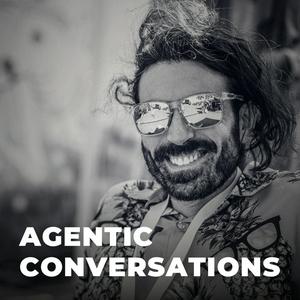
Acerca de Agentic Conversations (formally mlops.community)
Relaxed conversations and technical deep dives around AI Agents. This Show is brought to you by the Agentic AI Foundation where the leading agentic open-source projects like MCP, Agents.md, and Goose live. See more at aaif.io
Sitio web del podcastEscucha Agentic Conversations (formally mlops.community), Día Uno y muchos más podcasts de todo el mundo con la aplicación de radio.net
Descarga la app gratuita: radio.net
- Añadir radios y podcasts a favoritos
- Transmisión por Wi-Fi y Bluetooth
- Carplay & Android Auto compatible
- Muchas otras funciones de la app
Descarga la app gratuita: radio.net
- Añadir radios y podcasts a favoritos
- Transmisión por Wi-Fi y Bluetooth
- Carplay & Android Auto compatible
- Muchas otras funciones de la app
Agentic Conversations (formally mlops.community)
Escanea el código,
Descarga la app,
Escucha.
Descarga la app,
Escucha.
Agentic Conversations (formally mlops.community): Podcasts del grupo
 México